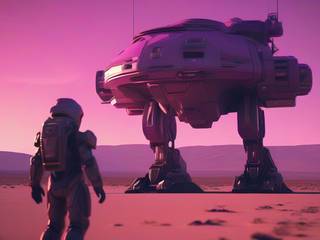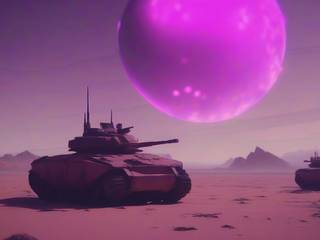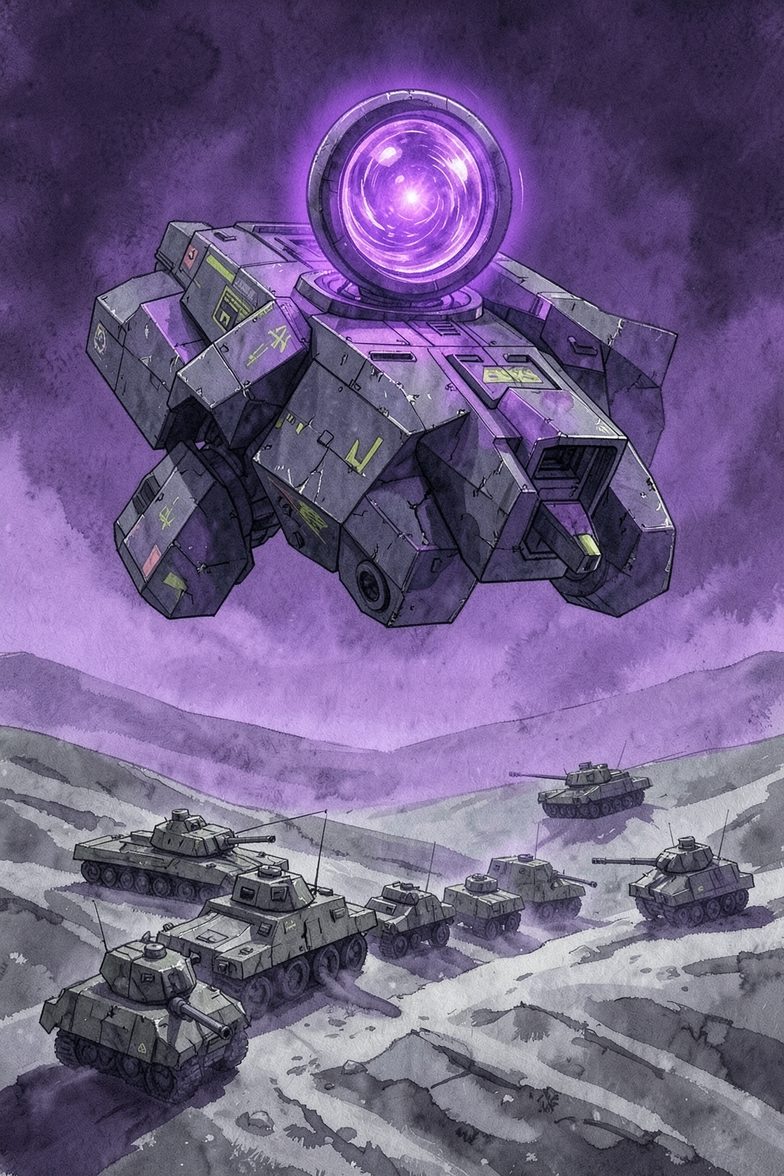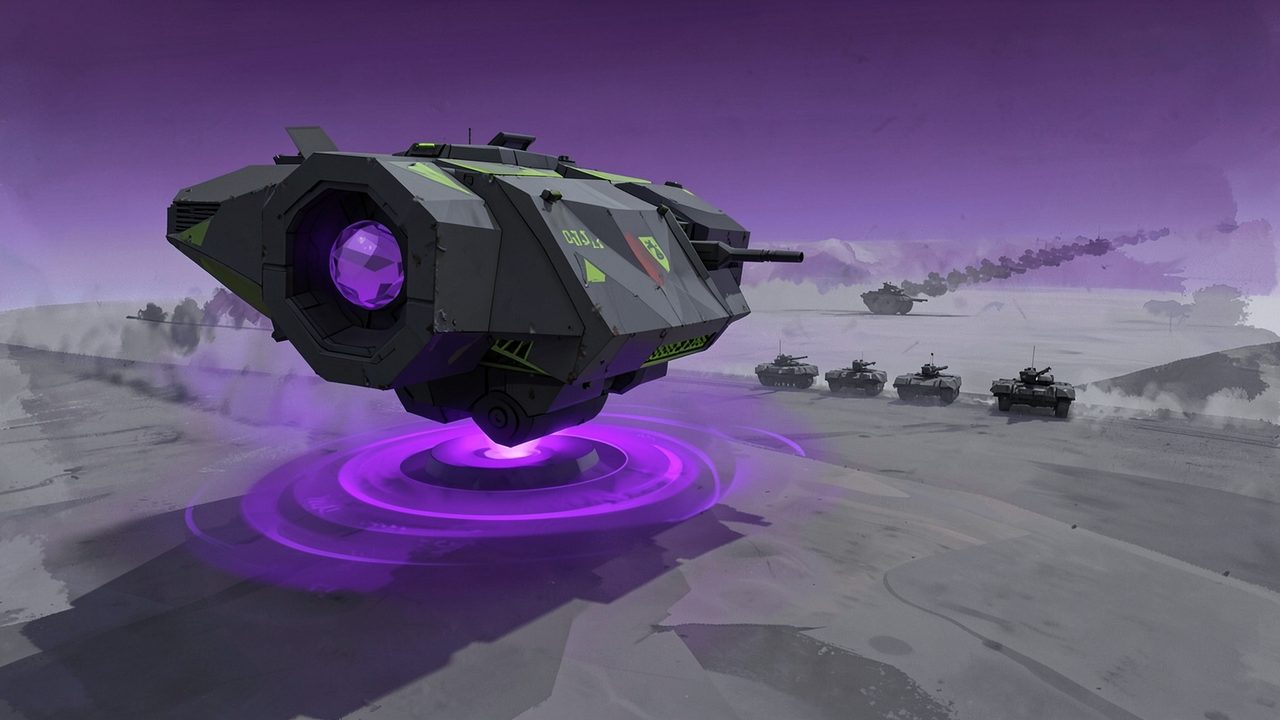
A heavy armored hover machine floats above a barren grey plain on a violet gravity field, a glowing violet orb in its launcher, a column of tanks behind it.

Graviton Singularity MechaPhysics Missile Mayhem

Reactorcore's Personal Game Design Project

Free to forkNo licence and no copyright claim: build this game under your own name, or lift one idea from it. Why?

Game overview

Graviton Singularity Mecha is a top-down arcade defense game where you never shoot a tank to death. You fling orbs of gravity energy that knock tanks around, and the battlefield does the rest: tanks slam into walls, into each other, into the next tank in line, and the crashes cascade.

You pilot one experimental mecha against an endless, clumsy robot army on a barren frontier planet. Every stage is a short, deliberate puzzle of angles and momentum, played at your own pace, with slow motion on tap and a trajectory line that shows where each shot will bounce.

It grows out of the Momentum Missile Mayhem series and Siege Tank Defence, and keeps the moment those games did best: the shot that sends one tank flying into three others.

Target audience

Players who love the click of a perfect bank shot: pool, pinball, angle-and-ricochet puzzles, physics toys and slow, thoughtful tower defense.

They want to feel clever and powerful in short sessions, without needing twitch reflexes or a free weekend.

The controls are mouse and WASD. Precision comes from thinking, not reaction speed: slow motion, a predicted trajectory, and weapon wheels that stop time while you choose.
Game's purpose

Play and silliness: cascading crashes so extreme they're outright funny.

Power: one machine against an army, beating it by turning its own weight against it.

Mastery: reading angles, chaining knockbacks, and finding the one shot that does the work of ten.

It deliberately avoids draining rest (a slow pace, and waves arrive sooner only if you clear them sooner) and clarity (every enemy shot is telegraphed, every orb's path is shown).

Core concept

Tower defense usually ramps up its waves until you lose, and keeps its best toys behind upgrades you grind for.

Here every weapon is yours from the first stage. A campaign is ten stages with a randomly shaped difficulty curve, and winning is normal.

When one region is clear, the planet has another: an endless supply of fresh campaigns, so the fun lives in the shots, not in a progress bar.

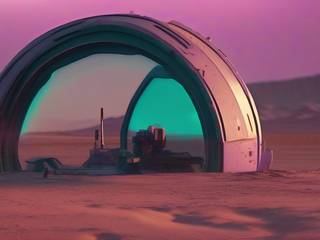
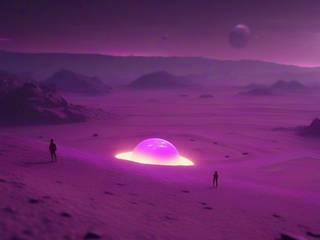
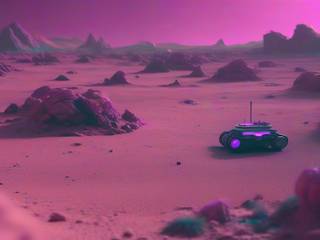
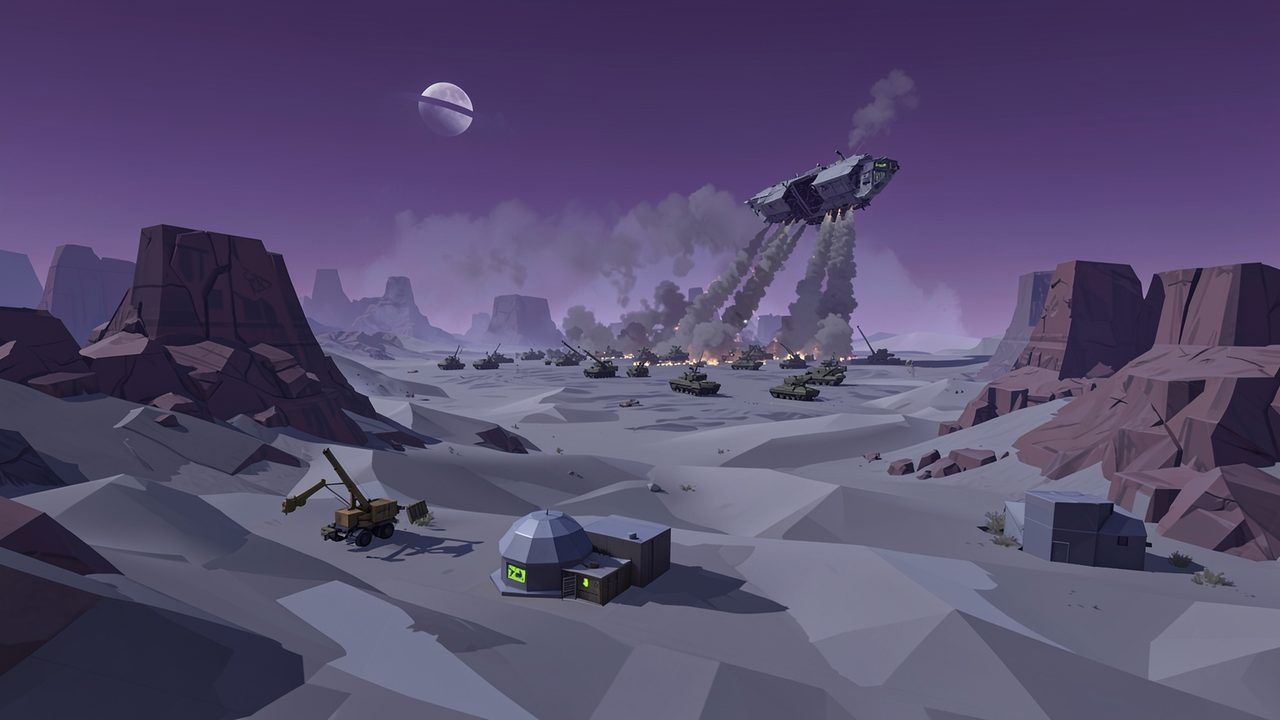
A barren frontier planet of grey plains and mesas, a domed lab and a mining rig in front, a landing craft trailing smoke over a column of tanks on the horizon.
"The Masterless Legion is still following its last order, long after the people who gave it are gone."

Lore and story

The Masterless Legion

Somewhere far out in the Milky Way, a world at war built a last-resort weapon: a planet-wide, fully automated robot army with a single directive, to wipe out the enemy if everything else failed. Someone switched it on, and nobody was left to switch it off.

The army outlived its makers. It left its dead world and drifted from star to star, hunting anything humanoid, until it crawled into the edge of human colonial space. Today it's classified as just another space monster: huge, relentless and completely mindless. (It's a nod to the Death Force of the anime M.D. Geist.)

The planet

The game takes place on a large, barren planet at the frontier, home to mining facilities and remote labs where exotic weapons can be tested without worrying about collateral damage. That's where the Legion lands, and where the answer to it was already being built.

The mecha

The Graviton Singularity Mecha taps the planet's own gravity field. It moves by falling into gravity pockets it creates, and fights by flinging orbs of gravity energy from a slingshot. It's close to useless in the air and in space, but on the ground of a big planet, one of them can take apart an army by letting the army do the work.

The Legion is the perfect target: huge, slow, crude and unable to steer around itself. It's high-quality invention against wasteful brute force.

The job right now

Clear the planet one region at a time and keep the Legion off it. The Legion's origin is found and ended in a later story. This game is about holding the line, and the stragglers never stop coming.

Controls and interface

You control one mecha from above. It doesn't walk or fly: it creates a gravity pocket and falls into it, so it slides across the battlefield up to a top speed, with a little drift when it stops.

Move

W A S D
Slide in any direction
Q
Anchor mode: lock in place, immune to pull and knockback

Fire

Mouse
Aim; distance from the mecha sets launch power
Left click
Launch the readied orb or shot
Right click
Hold to raise the shield

Wheels (time stops while open)

Z
Weapons: orbs, cannon shots, artillery
X
Powers, cast at the pointer
C
Turrets, deployables and structures

Time

E
Slow motion (0.1x) for up to ten seconds
Esc
Pause

With an orb readied, a trajectory line shows its path through up to four bounces, and how fast it'll be going at each one. The wheels show each weapon's stats and when it's the right tool, so a new player can learn the arsenal while time is stopped.

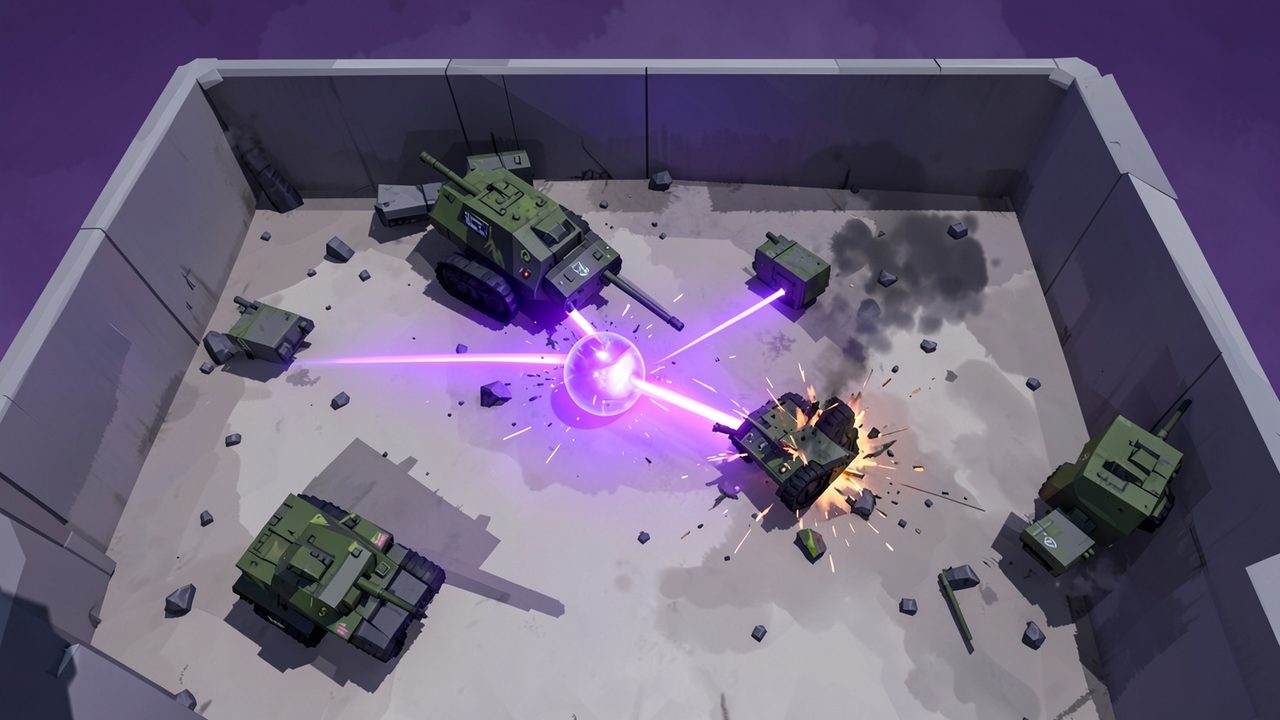
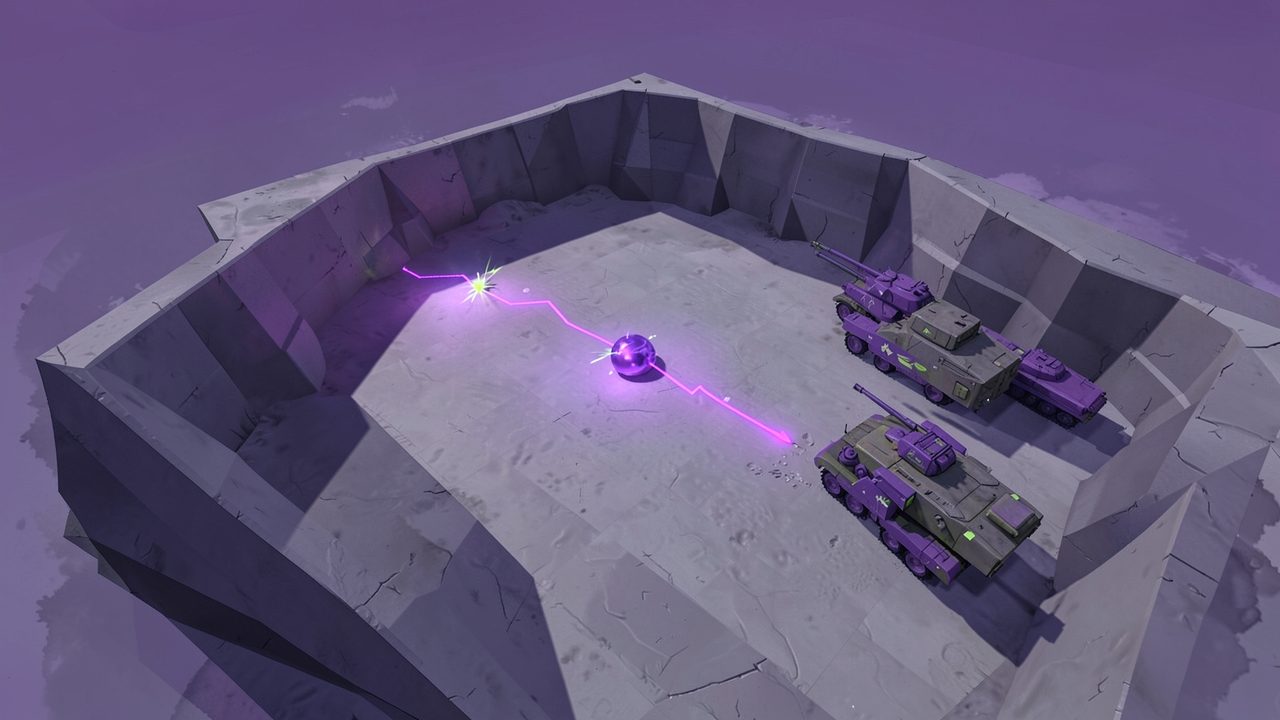
Top-down view of a walled arena: a violet orb streaks between tanks, one of them exploding, debris scattered across the floor.
"The orb does little damage on its own. The tank it knocks into a wall does the rest."

Game layers

  1. 01 · Moment-to-moment

    One stage, a few waves

    A wide, walled arena seen from above. Tanks roll in from an open edge in waves of two to ten, never more than about ten at once. You slide out of their firing arcs, read the angles, and launch.

    The best shots rarely go straight at a tank. They go into a wall at an angle and come back into a tank's side, sending it into the wall or into its neighbor. A shield raised at the right moment can even catch a shell meant for the base you're guarding.

  2. 02 · Low metagame

    A region campaign

    A campaign covers one region of the planet: a map of hotspots where the Legion has landed. You choose where to deploy. A campaign runs to ten stages, each with one to five waves, and the difficulty of each is random: easy, medium and hard in any order, sometimes the same arena several times in a row.

    When every hotspot is clear, a final stage opens, where the Legion's remnants regroup around a boss that appears nowhere else. Every stage is one of four types:

    Stage typeWhat the tanks doYour job
    Base defenseLand outside the anti-air fort's range and roll in to shell itStop them before they're in range
    ConfrontationDrop into an arena and turn to face youAn all-out brawl, a demolition derby
    AmbushFlee across the map, or run a convoy through itPlay goalkeeper: let as few through as you can
    Base assaultPour out of a factory base under artillery coverSlam its own tanks into the base until it breaks
  3. 03 · High metagame

    The planet

    The whole planet is a generator of region campaigns, and each one gets a twist: a different biome (desert, snow, ice, ashen wasteland, barren soil), a shorter or longer run, a hotter or calmer one, a lean toward one stage type, a different set of weapons on hand.

    Because the planet sits on the frontier, the Legion keeps coming back, so there's always another region to clear. The planet map remembers every region you've cleaned up, and after a hundred campaigns it marks the invasion as broken: from then on, it's only stragglers. That's a record of what you did, not a prize.

  4. 04 · Practical game flow

    A coffee break or an evening

    Launch straight to the planet map, pick up the region you were working on or start a new one, and choose a hotspot. A stage takes a few minutes.

    Stop after any stage and the campaign waits exactly where you left it. Play one stage over coffee or a whole region in an evening; nothing in the game cares which.

Game modes

There's one mode, on purpose: the planet campaign. It already covers every session length, because it's built in nested pieces you can stop between:

The planetEndless: region after region, as long as you like to play.
A region campaignTen stages and a boss: an evening or two.
A stageOne to five waves in one arena: a few minutes.
A waveTwo to ten tanks: a minute or so of lining up shots.

The pace is slow and strategic throughout. Waves arrive sooner when you clear them sooner, so a confident player speeds the game up and a careful one never gets rushed, and there's always a short break between waves.

Features and mechanics

  1. The heart of it

    Bank shots and the trajectory line

    The mecha's main weapon is a slingshot that makes orbs of gravity energy. Aim with the mouse; how far the pointer is from the mecha decides how hard the orb is flung. A new orb takes a moment to form after each launch.

    An orb bounces off walls, obstacles and tanks until it runs out of momentum or time, then detonates in a last EMP and plasma blast. While you aim, the trajectory line shows its path through up to four bounces and its speed along the way, so you know exactly which hit you're setting up before you take it.

    A shot fired straight at a tank scores one hit and flies off. A shot banked off a wall into a tank's side sends it sideways into the wall, or into the tank next to it. Learning to see those angles is the game.

    A walled arena seen from above: a violet orb flies along a bright zigzag path toward two tanks parked by the wall.
    "The trajectory line shows four bounces ahead, so you can see the hit before you take it."
  2. Chain reactions

    Knockback is the damage

    An orb hitting a tank does little damage by itself, plus a brief EMP stun. What hurts is the impact that follows: the tank thrown into a wall, into another tank, or into a whole line of them. Those collisions cascade, and wrecks and explosions keep pushing their neighbors.

    The Legion makes this easy. Its tanks are heavy, slow and can't steer around each other, and the arenas are laid out so they drive in straight lines, which bunches them together. They even crash into each other by accident. The biggest moments are the ones where one well-placed orb sets off a pile-up across half the arena.

  3. Gravity-well propulsion

    Moving by falling

    The mecha moves by creating a gravity pocket and falling into it. It slides rather than walks, up to a top speed, which makes keeping your distance and side-stepping a slow shell feel smooth and deliberate.

    The shield holds about five seconds of protection and recharges slowly, so it's for a well-timed tap just before a hit, not for hiding behind. Anchor mode locks the mecha to the ground: nothing can pull or push it, and it fires harder and faster, but it can't dodge, and switching in or out takes two seconds. It's also the answer when your own vortex or shockwave goes off a little too close.

  4. Thinking over reflexes

    A slow, honest pace

    Every Legion weapon telegraphs before it fires, and its shells are slow and only moderately damaging, so the mecha survives several hits. Nothing kills you without warning.

    Slow motion drops the game to a tenth of its speed for up to ten seconds, recharging slowly, for lining up the shot that matters. The weapon wheels stop time completely while they're open.

    The pace stays in your hands: clear a wave quickly and the next one comes sooner, take your time and it waits, with a short break between waves either way.

  5. Everything from the start

    The arsenal

    Nothing is locked, bought or earned. Every weapon is available from the first stage, and powers draw on a reactor charge that refills over time, which is the only limit on how often you use them. Now and then a campaign's twist leaves a few weapons out, so you get to play with a different kit.

    KindWhat's in it
    OrbsEight kinds, among them a regular orb, one that speeds up with every bounce, a sticky one that lodges inside a tank and tears it apart, a brute-force orb with huge knockback, a split shot that becomes two on its first bounce, and a singularity orb that drags everything with it without colliding itself
    CannonDirect shots: small, medium, EMP and mini-nuke
    PowersShockwave, implosion, hack and stun, gravity grip (pick up a tank and throw it), orb grip (catch a flying orb and re-throw it), singularity vortex, drone swarm, airstrike, artillery, antimatter shot, and a nuke that's dangerous up close
    DeployablesMagnet trap, shockwave tower, orb accelerator, and mines (regular and nuclear)
    TurretsBlaster, beam and drone

    The colony's supply pods sometimes drop temporary boosts: faster orbs, faster energy and repairs, no cooldowns, more ammunition, a stronger shield or quicker movement.

  6. Brute force by design

    A clumsy enemy

    The Legion fields armored tanks, cars and walkers on treads and wheels, in small, medium and large sizes. Their guns are fixed, turreted (all the way round or only within an arc), or mounted in sets that fire together, like three cannons across the front.

    They drive straight at their target, turning slowly to bring you within a narrow arc before they advance. Each type has a role, a strength and a weakness to learn, the way Doom 2's monsters do: some you must never let close, some you should never stand in front of, some are best used as ammunition against the others.

Box art: an armored hover machine with a huge violet orb on top floats above a column of tanks on a barren plain.

The Legion has landed

Graviton Singularity Mecha: Physics Missile Mayhem

An army with no makers, no plan and no brakes is rolling across the frontier. You have one experimental mecha, a planet's worth of gravity and a slingshot full of orbs.

Line up the shot. Bank it off the wall. Send the first tank into the second, and the second into the rest. Region by region, the planet gets quieter.

Every tank they send is ammunition.