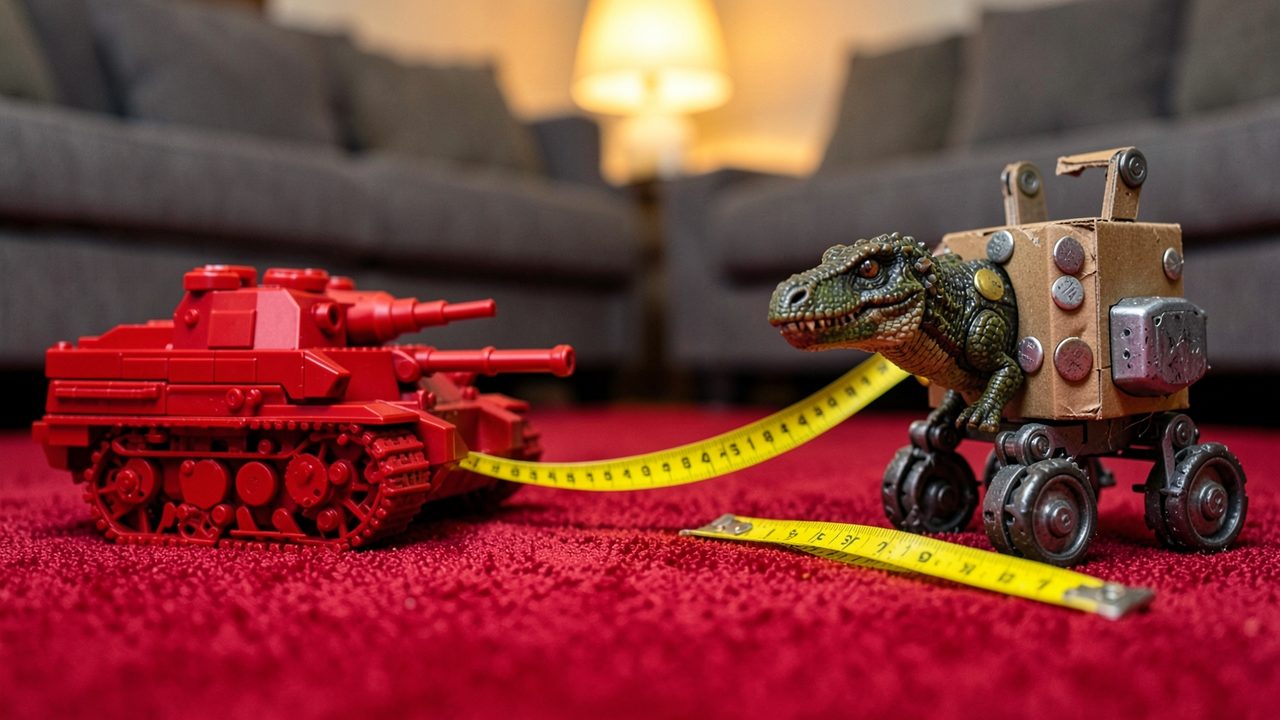
On a deep red living room rug, a red brick-built toy tank faces a toy dinosaur riding a wheeled cardboard robot, a yellow tape measure stretched between them, a sofa and a glowing lamp behind.

Epic Toy Cool CombatTape Measure Tactics

Reactorcore's Personal Game Design Project

Free to forkNo licence and no copyright claim: build this game under your own name, or lift one idea from it. Why?

Game overview

Epic Toy Cool Combat is a turn-based tactics game played in real life, on the floor, a table, a bed or the garden, with the toys you already own. Brick-built figures, action figures, robots, dinosaurs, tanks, teddy bears and cardboard creations all fight under one set of rules. All you need besides them is a tape measure and one die.

There are no stat cards. The model is the stat sheet: what a unit carries is what it can do, and the parts you can knock off it are its health. A hit sends the part flying across the table, and the unit can go and pick it back up.

It began as a way to give toy battles rules, so that distances and dice decide what happens instead of whoever narrates hardest. The turns borrow XCOM's clarity (three units, three actions each), and the "build anything" spirit comes from BrikWars and Mobile Frame Zero, the free wargames for construction toys. The aim is the depth of a good tactics game with none of the bookkeeping of a big tabletop wargame.

Target audience

Anyone who ever staged a battle with their toys on the living room floor and wanted it to really count: builders of construction toys, collectors of action figures, crafters, and fans of XCOM-style squad tactics.

They bounce off thick rulebooks, stat cards, point costs and expensive proprietary miniatures, or simply don't have a free weekend to learn them.

The interface is a tape measure, one die (or a coin) and a single printed reference sheet. Seven-year-olds can play it, and nobody outgrows it.
Game's purpose

Creation and play: designing your own warriors and machines, then watching them come alive in a fight.

Silliness and excitement: helmets and cannons flying across the table, a tiny figure with a giant gun taking down a tank.

Celebration and meaning: cool moments worth retelling, kept in a war diary that grows season by season.

It deliberately avoids draining ease (nothing to track on paper during a fight), money (scrap crafts are as valid as boxed sets) and respect (nobody touches anyone else's toys, and both sides agree the fight is fair before it starts).

Core concept

Tabletop wargames usually ask for a unit card, a points list and a rulebook for every model, and a match ends and is forgotten.

Here what you see is what you have. Health, armor, weapons and speed are read off the model itself, and every hit changes the model in front of you, so nothing needs tracking.

Battles are scenes in a season that a dice-driven generator keeps writing, so every fight adds to a story that goes on as long as you like.

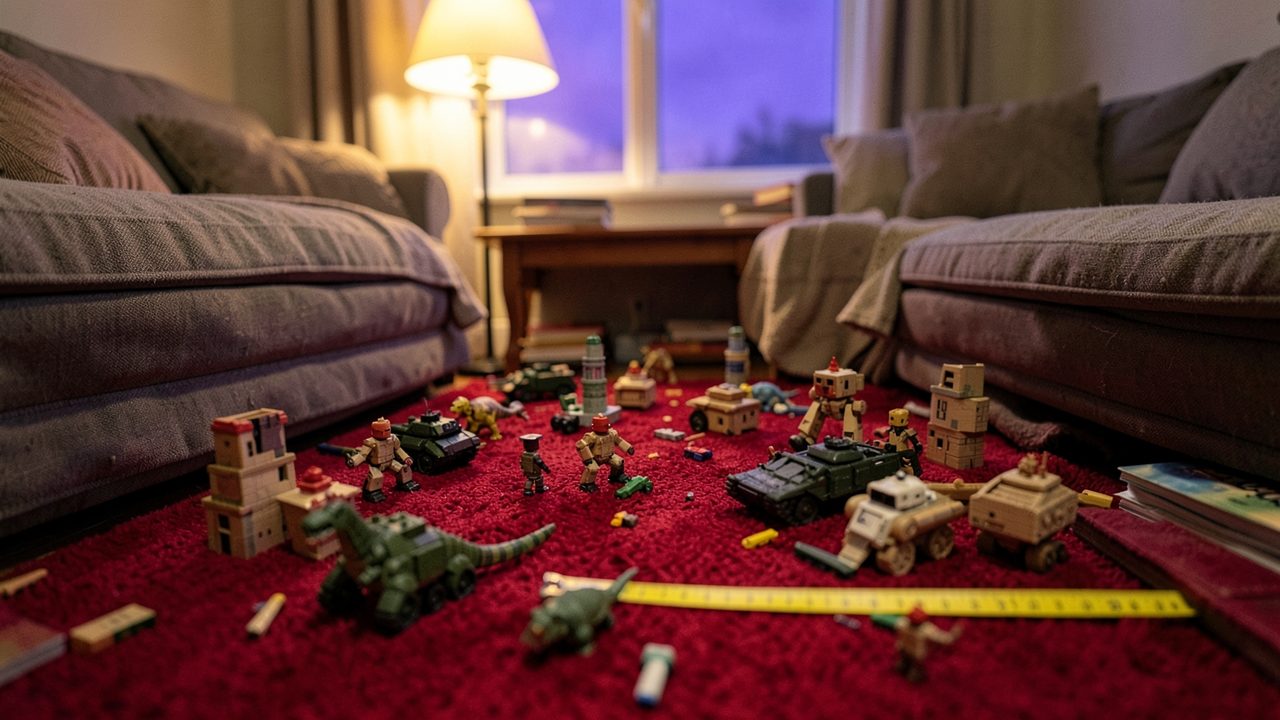
A living room at dusk turned into a battlefield: toy tanks, dinosaurs, soldiers and cardboard robots spread across a red rug between the sofas, a yellow tape measure unrolled through the middle.
"The battle gods can summon anything that moves and can carry a weapon: a brick-built knight, a robot made of cardboard, a teddy bear with a rocket launcher."

Lore and story

The battle gods

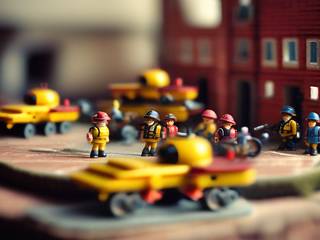
Somewhere above the living room live the immortal battle gods, and they share one overwhelming desire: to engage in EPIC TOY COOL COMBAT. With a surge of their power they assemble, arm and awaken inanimate creations, raise them from the toy box, and send them to fight the creations of the other gods for everlasting glory and epic, cool memories.

You are one of those gods. Take command of your forces.

Anything can answer the call

A god may call any creature, person, machine or thing into battle through a physical toy: construction bricks, action figures, dolls, teddy bears, model kits or do-it-yourself creations. Only three things matter. It can move, it can carry weapons and armor that come off and go back on, and it's epic, which means whatever its god loves about it.

Why the gods fight

Sometimes cool combat settles a dispute. Sometimes it decides who gets a prize that can't be shared. Most often it's simply to create cool situations, regardless of victory or loss, and to have a story worth telling afterwards.

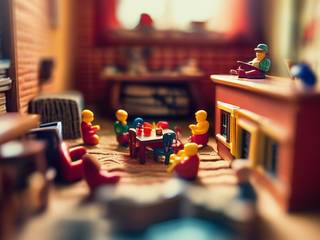
Right now, the gods are choosing their champions. The rug is the battlefield, the books are mountains, and the sofa is a cliff.

Controls and interface

The controls are your hands, and the interface is the table. Everything is measured in centimetres with full 360° freedom, up and down included, so there's no grid, no hexes and no board to buy.

The kit

Your toys
A unit or an army per side, built before the game
Tape
A retractable tape measure, 3 m is ideal: every move, range, blast and knockback
One die
A six-sided die, or a coin to flip
Notebook
Pen and paper (or a web app) for the war diary, never for the fight
One sheet
The printed A4 reference: distances, chances and tiers at a glance

A unit's actions (three per turn)

Move
Measure and move, then choose which way to face
Attack
Fire or swing one weapon at one target
Ability
Boost, grapple, pull, push, build cover, take control
Recover
Pick up a lost part and snap it back on
Interact
Grab, install, operate, board or bail out

A turn is short by design. You pick up to three of your units, and each gets three actions in any order and combination: move-move-move, move-attack-move, attack-attack-recover. The rest of your army waits. However large the armies get, nobody waits long for their turn.

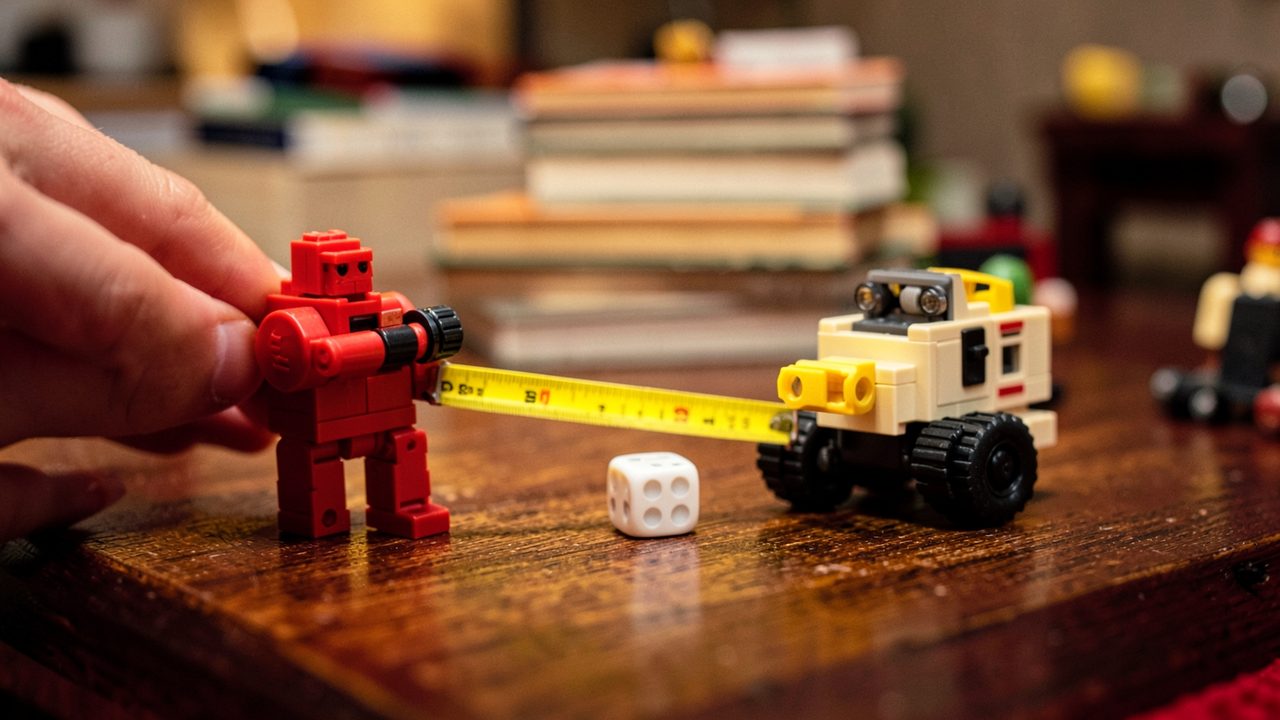
On a wooden table, a hand holds a red brick-built toy robot while a yellow tape measure runs from it to a small cream toy truck, a white die between them and stacked books behind.
"Close enough to touch is a sure hit. Across the room is a long shot. The tape measure settles every argument."

Game layers

  1. 01 · Moment-to-moment

    Measure, roll, knock it off

    Pull out the tape, see which range band the target is in, and roll. If it hits and the defender's dodge fails, the defender picks a part to lose, and the unit is pushed back along the line of the shot while the part flies twice as far.

    Then the question every turn turns on: chase the part you lost, cover a friend, or press the attack while the enemy is stripped bare?

  2. 02 · Low metagame

    A battle with a mission

    Every battle has an objective, and the battle ends when it's done or failed. Most missions aren't about wiping out the other side:

    MissionWhat it asks
    Take down the leaderDestroy one named unit: a commander, a hero, an ace, a hivemind
    NemesisDestroy a unit that comes back twice: it has three lives
    Guard or destroyA reactor, pylon, radar, artifact or planetary gun that isn't part of either army
    EscortA convoy, a civilian or a carried object that can't move itself; its protector moves it as an extra unit
    Delivery and assemblyCarry a number of objects to a place, or build something from parts scattered across the room
    Race and breakthroughReach a place first, or break through a blockade while the other side holds it
    Hold the prizeKeep a special object, or a hill, for a number of turns
    Wipe them outThe classic: the last side standing

    Sides start about three metres apart, beyond the reach of any weapon, so the opening turns are about positioning, like the first moves in chess. Ambushes and standoffs can start anywhere.

  3. 03 · High metagame

    The war diary

    Battles can be one-offs, but they're meant to add up. The game is structured like a cartoon series: a season is a whole war, an episode is a campaign within it, and each battle is a scene. A war diary records every one of them: who fought, what happened, the coolest moment, who fell.

    The next scene isn't invented on the spot. A few decision sheets, driven by the die or by a vote, roll it up from what came before: where it picks up, the starting positions, how the forces compare, the main and side objectives, and special events, like a strong wind that pushes every unit ten centimetres to the left. Each episode continues from where the last one left off.

    Armies change as the war goes on. New units can join between battles, and the last unit destroyed in a battle retires for the rest of the season, its story written into the diary. Nothing un-happens. When a season ends, the next one picks up its threads.

  4. 04 · Practical game flow

    Set up in minutes, pack up in one

    Bring your units already built. Make terrain out of whatever is in the room: books, cushions, boxes, the furniture itself. Show each other your units, roll or pick the scene, and start.

    A one-on-one duel fits in a short sitting, three against three is a relaxed evening, and nine against nine or more is a proper battle. Afterwards, snap the loose parts back on, the toys go back on the shelf, and the diary waits for the next scene, next week or next year.

Game modes

The same rules serve every table. Who's playing decides the mode:

ModeWho playsWhat it's for
SoloYou against an army the die commandsRule-bound toy battles alone, where you can't simply decide who wins
TogetherFriends side by side against a dice armyA shared war, with every player commanding their own units
SparringTwo or more gods, or teams of them, by agreementFriendly play-fights that everyone agreed to, and a chance to show off what each of you built; two to four sides is the sweet spot
SpectateThe die against the dieWatching two armies fight it out, or testing a new unit

The dice commander runs any army nobody is playing. At the start of each of its units' activations, roll the die and follow the result, moving its toys for it:

RollThe unit will…
1 · ChargeAttack the nearest enemy aggressively, ignoring the objective
2 · ObjectiveGo for the mission objective, whatever it takes
3 · RecoverTake cover, pick up lost parts, hide
4 · RepositionMove to better ground: higher up, a flank, behind cover
5 · SupportJoin up with the nearest ally, or attack carefully from range
6 · ChaosRoll again for a direction (north, east, south, west, toward the nearest enemy, away from it), move that way, and shoot whatever it can see

The commander always takes the likeliest shot its result allows, and activates the three units closest to the action. That's enough to make it unpredictable without making it stupid.

Four variants change the rules themselves, and mix with any mode:

Features and mechanics

  1. No stat cards

    What you see is what you have

    Every unit is described by its physical model. A long barrel is a long-range gun, a thruster pack means it's fast, a thick shield wall on one side is armor on that side. Other wargames define all this on a card; here the toy itself is the card, and everyone at the table can read it.

    So every weapon and ability must be visible and recognizable to the other players, who agree it's valid. That consent is the balance system, together with a simple rule of believability: cheap, fast, good, pick two. Something huge is powerful but heavy; something light is weak or short-ranged. Before the first battle, everyone shows their units (a photo and a few words can go in the diary) and checks that each side has at least one weapon that can hurt the other side's toughest unit.

    Units come in four sizes, judged by what they can do more than by their exact size:

    SizeWhat it isParts
    FigureAnyone with two arms who can ride or pilot something; about 4 cm3
    SteedA horse, bike, small car, power armor, bear, small turret; 5 to 10 cm5
    VehicleA tank, jet, mecha, dragon, gunship, a whole house; 10 to 20 cm10
    TitanA giant mecha, battleship, mobile fortress or kaiju; 20 cm and up20
  2. The heart of it

    Parts are health, and hits are physics

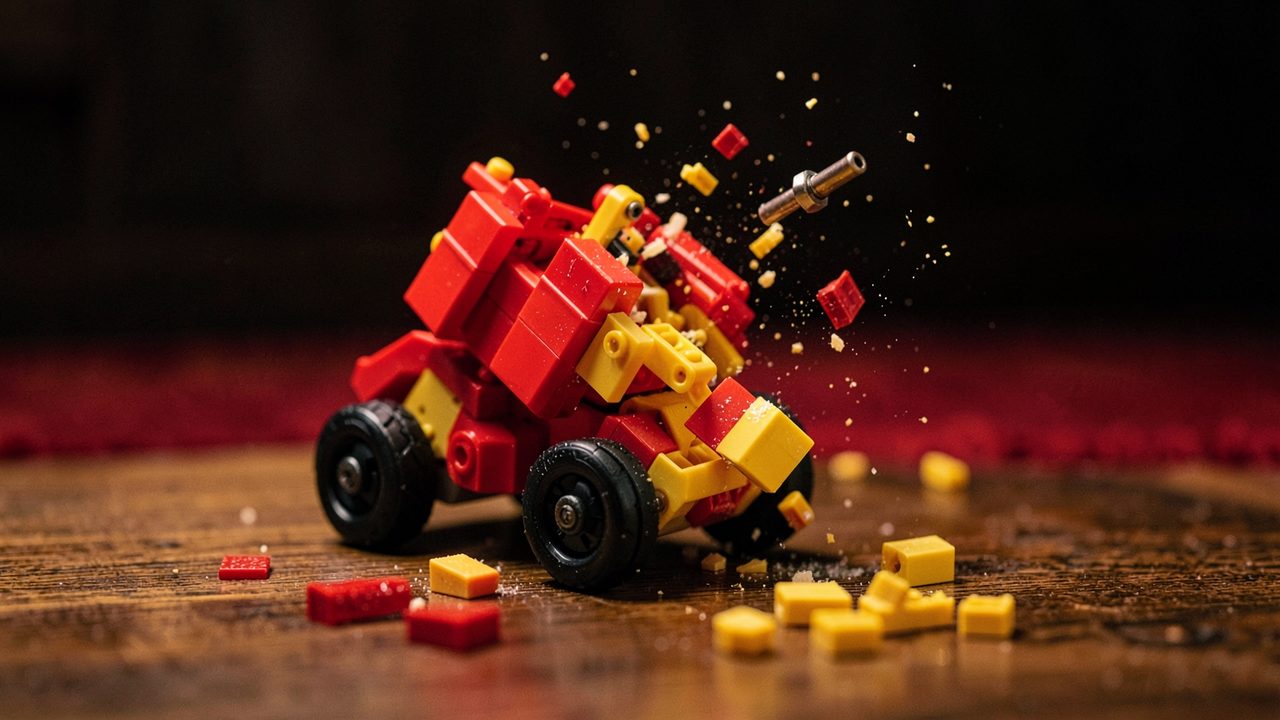
    A unit's health is the stuff attached to it: hats, helmets, held weapons, backpacks, armor plates, turrets, wings. Each size can carry a set number of these parts (above). One successful attack removes one part, and the defender chooses which, so they decide what they can live without.

    1. Roll to hitThe range band sets the chance.
    2. DodgeThe defender gets one roll for the whole attack.
    3. Lose a partThe defender picks it and takes it off.
    4. KnockbackThe unit slides back along the shot; the part flies twice as far.

    When the parts are gone, the next hit takes its propulsion: a figure loses its legs and crawls, a vehicle is laid on its side and can't move. The hit after that breaks its core, a head or a reactor, and it's out of the battle. A fully armed figure takes five hits; a titan takes twenty-two.

    Only things that come off easily count as parts. Arms and hands are never pulled off a figure; the weapon in the hand comes off instead. A toy whose weapon is built into its body gets an armor plate to stand in for that health, and it keeps the weapon until the end.

    A red and yellow brick-built toy vehicle tips back on its wheels as bricks and a small cannon burst off it, loose bricks scattered across the wooden table.
    "Every hit knocks a real part off the model, and the part flies twice as far as the unit is pushed."
  3. Healing is a place on the table

    Recover and deny

    Lost parts aren't gone. They lie where they landed, and a unit within reach of one (5 cm for a figure, 10 cm for a machine) can spend an action to recover it: an even chance, and on a success it snaps back on with everything it did. A unit can pick up a part an ally dropped, too, as long as it stays within its own size's part limit.

    Healing means walking out to where your helmet landed, possibly into the enemy's line of fire. And the enemy can deny it: attacking a loose part knocks it further away, so you spend more actions chasing it. Every lost part becomes a small objective of its own.

    Nobody touches, steals or uses anyone else's toys. Each god handles only their own creations.

  4. Short turns, real choices

    Three units, three actions

    Each turn you activate up to three units, and each takes three actions in any combination. With a big army you choose which three matter most this turn; the rest stand ready. There are no overwatch or reaction rules: the turn is yours, then it's theirs.

    Every move is measured from the unit's centre, in any direction, up and down included. After moving, a unit chooses which way it faces, which matters for armor, weak points and front-firing weapons:

    WhoPer move action
    Figure30 cm, or 15 cm when slow
    Steed, vehicle, titan40 cm, or 20 cm when slow
    Jets60 cm, mostly straight ahead (a 10 cm sidestep); turning in place costs an action
    Boost, jump or dash ability50 cm (30 cm when slow); 100 cm for jets
    Crawling10 cm, once the legs or wheels are gone

    A figure becomes slow by carrying a heavy (tier 3) weapon or bigger. A machine becomes slow by being built with heavy or super armor, unless it carries add-on thrusters, which are parts too: shoot them off and it slows down.

  5. One die or a coin

    The chance ladder

    Every roll in the game is one of four steps on a single ladder, and each step works with a six-sided die or with coin flips, which give nearly the same odds:

    ChanceDieCoinsUsed for
    Sureno rollno flipMelee, and attacks at close range (up to 10 cm)
    Likely3 to 6two flips, either headsMedium range (up to 25 cm); everyday abilities like a boost or a jump
    Even4 to 6one flip, headsLong range (up to 50 cm); recovering a part; strong abilities like a grapple or a tractor beam; dodging a blast
    Long shot5 or 6two flips, both headsFar range (up to 1 m); dodging an attack; outrageous abilities like mind control

    Range bands double for weapons fired by vehicles and titans, and nothing reaches beyond 2 m, however big the gun. A visible targeting part (a scope, a radar dish, a sensor eye) moves a shot one step up the ladder, though never to Sure. Titans are one step easier to hit, because they're huge.

    The defender dodges once per attack, even when the weapon hits twice: one roll, and the whole attack misses or lands. It keeps turns quick and the odds easy to see.

  6. Bigger hits harder, and pays for it

    The tier ladder

    Weapons come in six tiers, and armor in five classes. A weapon hurts any armor up to its own tier, and simply bounces off anything tougher: the defender doesn't even need to dodge. The tier also sets how far a hit knocks the target back, and how wide a blast is.

    TierLooks likeHurts up toKnockback and blastThe catch
    1 · LightPistols, knives, fists, rocksUnarmored figures7 cmNone: it attacks twice per action
    2 · MediumRifles, blasters, swords, flamethrowersArmored figures7 cmBounces off every machine's armor
    3 · HeavyBazookas, miniguns, big hammers, heavy machine gunsLight armor10 cmMakes a figure slow
    4 · UltraA figure's oversized railgun or buster sword; autocannons, laser cannonsHeavy armor15 cmFires only to the front
    5 · SiegePlasma cannons, vehicle railguns, big missilesSuper armor25 cmVehicles and titans only
    6 · SuperweaponMega rockets, doom cannons, anything absurdEverything, two parts per hit, and the attacker picks them40 cmMakes its carrier slow, and fires only to the front

    Armor runs from unarmored and armored figures (a helmet or chest plate counts, until it's knocked off) through light armor (most steeds) and heavy armor (tanks, battle mechs) to super armor, a massive shield wall that covers one to three sides of a vehicle or titan. Figures and steeds carry weapons up to tier 4; vehicles and titans can mount anything.

    Vehicles can deploy with more than their ten parts, but the first hit on an overloaded vehicle makes it shed parts of its owner's choice down to nine. The urge to bolt armor onto every last surface is real; the game just doesn't let it last.

  7. Where you stand matters

    Facing, weak points and super armor

    Every unit has six sides: front, back, left, right, top and bottom. A side with thrusters, exhausts, a jetpack or an open cockpit is a weak point, and counts as one armor class lower. An armored figure with a jetpack is unarmored from behind, so even a pistol can finish it there. Speed and armor can live on one unit, but never everywhere at once.

    Super armor works the other way: only siege weapons get through it, so a weaker weapon has to find a side it doesn't cover. Flanking a fortress with a squad of figures carrying bazookas is a plan, not a hope.

    Hand-held and turret weapons fire in any direction. Built-in weapons fire only to the front, and so do ultra weapons and superweapons. A unit chooses its facing for free after a move, but turning in place costs an action. That's the trade: a built-in weapon can never be knocked off, while a turret swivels but can be lost.

  8. The fun stuff

    Specials, pets, pilots and rams

    • Blast, pierce and chain: a heavy or ultra weapon can have one of these, siege and superweapons can combine two. A blast hits everyone within its knockback distance of the target, allies and the shooter included, but its victims dodge at even odds. A piercing beam hits everything in a straight line, through walls. A chain bolt or ricochet must jump to one more unit within range, even a friend.
    • Thrown weapons: rocket fists, spears and axes can be thrown for a hit that takes two parts, but the weapon lands next to the target and has to be fetched back.
    • Pets and minions: a dog, a parrot, a swarm of bees or a little drone is a part, not a unit. It attacks in a straight line or around a corner, then comes home.
    • Pilots: most machines need a figure aboard to act, unless they show an antenna, an autopilot or are a creature with a mind of its own. A pilot in an open cockpit can be shot directly, at one step harder. A closed canopy saves them: when the machine is destroyed, the pilot pops out alive with whatever weapons were stowed aboard.
    • Slams and rams: every steed, vehicle and titan can slam something within reach, or ram it with a move. A steed can't ram a vehicle, a vehicle can't ram a titan; a titan can ram anything.
    • Abilities: boosters and wings move a unit further, grappling hooks and tractor beams move something else, aura bursts hit everything around it, and stranger powers move the terrain itself or take over an enemy for the rest of the turn (never to make it destroy itself).
  9. Any table, any budget

    Any toy, any scale

    Construction toys make it easy to build units with parts that snap off and back on, but nothing in the rules needs them. Units can be crafted from clean scrap: cardboard, bottle caps, popsicle sticks, tin foil, fabric, putty, origami. A box with eyes drawn on it is a valid unit, as long as its parts come off and everyone agrees what they are.

    A starter squad (a figure or two and a small vehicle) is a single small set, and one tape measure, one die and a notebook cost a few coins. A collection can grow into a titan-led army, but the game works just as well at the smallest size, so try it small first: it's far too easy to spend more than you meant to.

    The same rules shrink too. At micro scale, where a person is a single small brick and a mecha fits in your palm (as in Mobile Frame Zero), halve every distance and the game fits on a coffee table.

Trivia

Before settling on Epic Toy Cool Combat, the design notes went through a list of other names: Toy God Battles, Toy God Wars, Battle Toy Gods, Brick God Combat, Combat Bricks, Epic Toy Battles. The battle gods made it into the lore anyway.

The overloaded-vehicle rule exists because of a well-known joke among military vehicle fans: the compulsion to cover a tank in more and more explosive reactive armor blocks until there's barely a tank left underneath. A parts-as-health system makes that very tempting.

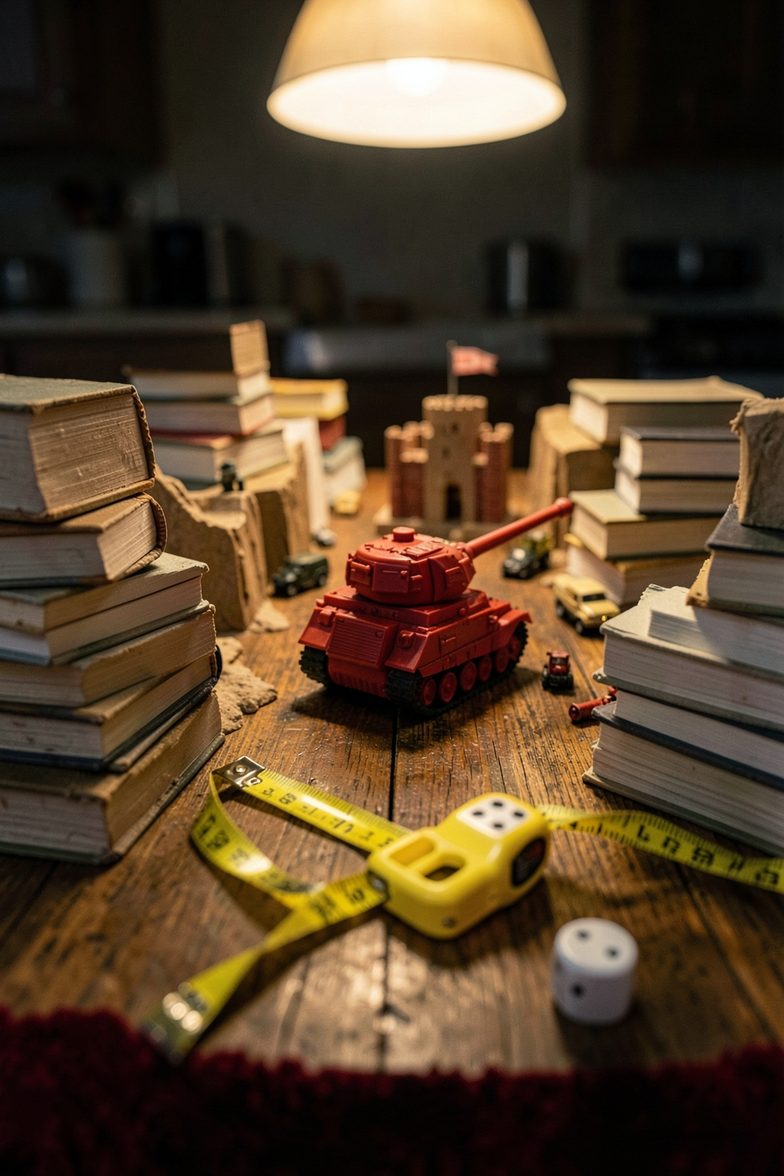
Box art: a kitchen table under a hanging lamp set up as a battlefield, a red toy tank and a small fortress with a flag between cliffs of stacked books, a yellow tape measure and a white die in front.

A summons from the battle gods

Epic Toy Cool Combat: Tape Measure Tactics

The gods are bored, and the toy box is full. Choose your champions: the knight with the bazooka, the cardboard robot, the dragon that's a little too big for its shelf. Arm them with everything they can carry. Then clear the rug.

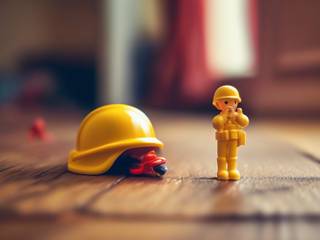
Measure the distance. Roll the die. Watch the helmet fly. Then send someone to go and get it back.

Bring your best toys. Bring a tape measure.