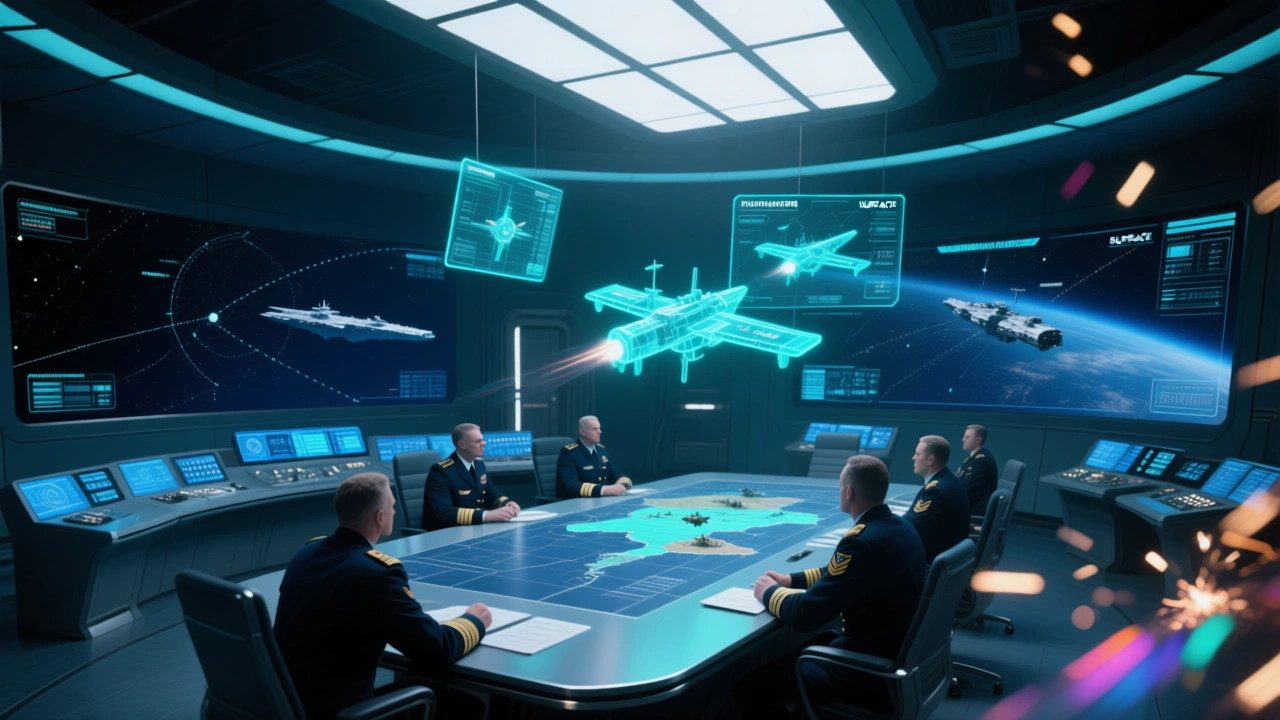
Concept art: officers in navy uniforms sit around a long map table in a curved command room, holographic aircraft and stations floating above it and wide screens showing a planet, star routes and warships.

Admiral Wars BeyondFour-Layer Grid Tactics

Reactorcore's Personal Game Design Project

Free to forkNo licence and no copyright claim: build this game under your own name, or lift one idea from it. Why?

Game overview

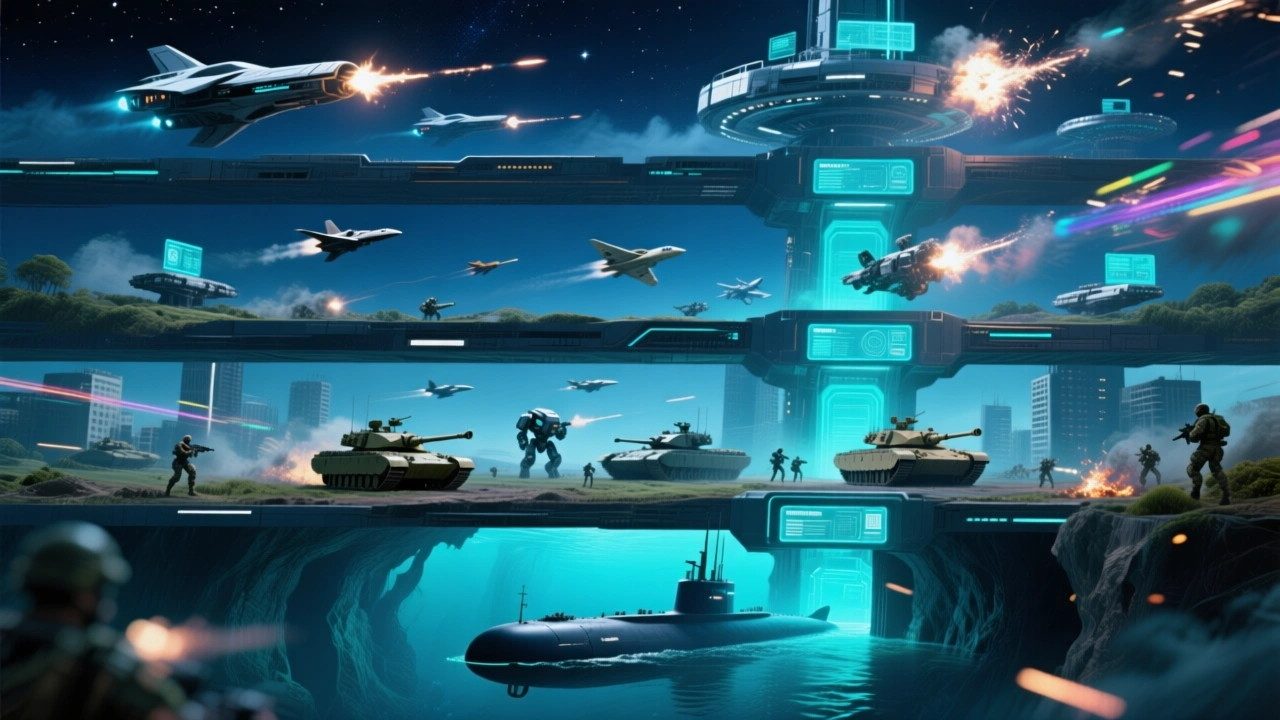
Admiral Wars Beyond takes the turn-based tactics of Advance Wars, almost one to one in how it looks and plays, and lifts it off its single flat map. A battle runs on up to four stacked layers of the same place, orbit, air, surface and underground or underwater, with units on each layer able to strike the ones above and below, and to travel between them.

Around the battles is a persistent universe that nobody scripted. A context-aware generator reads a passively simulated universe and offers you a handful of missions; what happens in each battle changes the places, factions and people you meet next. You play an admiral who chooses the next fight and the loadout to take, never a bureaucrat managing an empire.

It grows out of binge-playing Advance Wars 2 and Dual Strike, and borrows from a long shelf of others: Command & Conquer's base building and superweapons, Into the Breach's tile tactics, XCOM's living campaign, Fire Emblem's characters and Shadow of Mordor's rivals.

Target audience

Players who love Advance Wars' battles but found its campaigns a game of "Simon says", and its versus maps a reset to zero after every match.

They want to think every move through at their own pace, in a world where each battle counts for something.

The interface stays small: context menus that only show what's possible right now, a capped number of units, and layers that hide when they're not in use.

Game's purpose

Understanding and mastery: chess-like puzzles that change shape every time, on the easy side of hard.

Meaning and continuity: a universe you conquer, cultivate and keep safe like a garden, where nothing resets.

Connection: officers, rivals and allies you get to know over many battles.

It avoids draining rest and safety: it's turn-based all the way through, and every battle gives you a realistic chance to win or to pull out safely.

Core concept

Tactics games usually offer a handmade campaign that's played once, or skirmishes that leave nothing behind.

Here every mission is generated from the state of a living universe, with the variety of versus-mode settings and the meaning of a campaign at once.

Battles stay short and readable; the depth lives in the layers, the arsenal and the garage, there whenever you want to dig in.

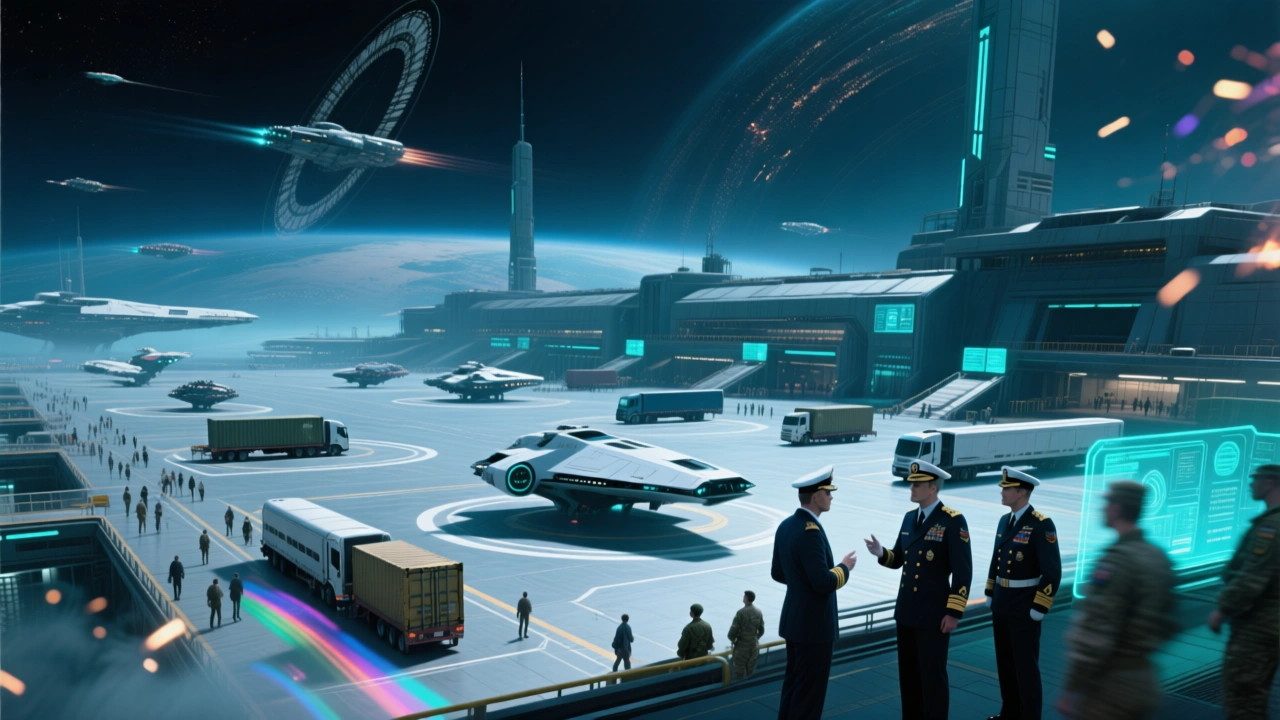
Concept art: three officers in dress uniforms talk on a busy spaceport apron, sleek shuttles and cargo trucks around them, a tall tower and orbital rings above a planet's curve in the sky.
"Every battle's outcome stays in the universe, and the next missions grow out of what happened."

Lore and story

The cache

It starts on one planet, on the ground. Your side fights its way across a single world toward a cache of alien technology, the only thing that could carry anyone off it. That first campaign is all surface, all familiar, the way tactics games usually play.

Then time skips forward. The cache gave your federation real space travel, and by now it has spread across solar systems, with orbital stations, colonies on strange worlds and fleets that need someone to command them.

The universe

The universe is shaped like a bowl: a settled center of galaxies that stay put, and edges that run on into wilderness. It isn't empty. Rival human powers with cultures and armies of their own, not palette swaps, share it with aliens, monsters and beasts, lost robots decaying in old wars, and hostile machine intelligences.

Gas giants, moons, asteroid belts, stars, starbases and megastructures are all places where battles happen, each with its own layers and terrain.

You

You're a battle admiral. The federation's politics, economy and borders run on their own, and you see them only as a read-only overview of how your battles have shifted things. Your decisions are the ones an admiral makes: which mission to take next, what to bring, and every move on the field.

Controls and interface

It plays like Advance Wars: move a cursor over a square grid, pick a unit, pick where it goes, pick what it does. The menus are context-sensitive, so a unit only ever shows the actions it can actually take from where it's standing. The layout below is a suggestion; mouse and gamepad work the same way.

Orders

Mouse
Move the cursor (or the arrow keys)
LMB, Z
Select, move, confirm an order
RMB, X
Cancel or step back
Enter
End turn

Layers and info

Wheel, Q E
Step up or down through the active layers
Tab
Show all layers stacked
Shift
Hold over a unit: range, vision and terrain bonus
Space
Your admiral's power, when charged

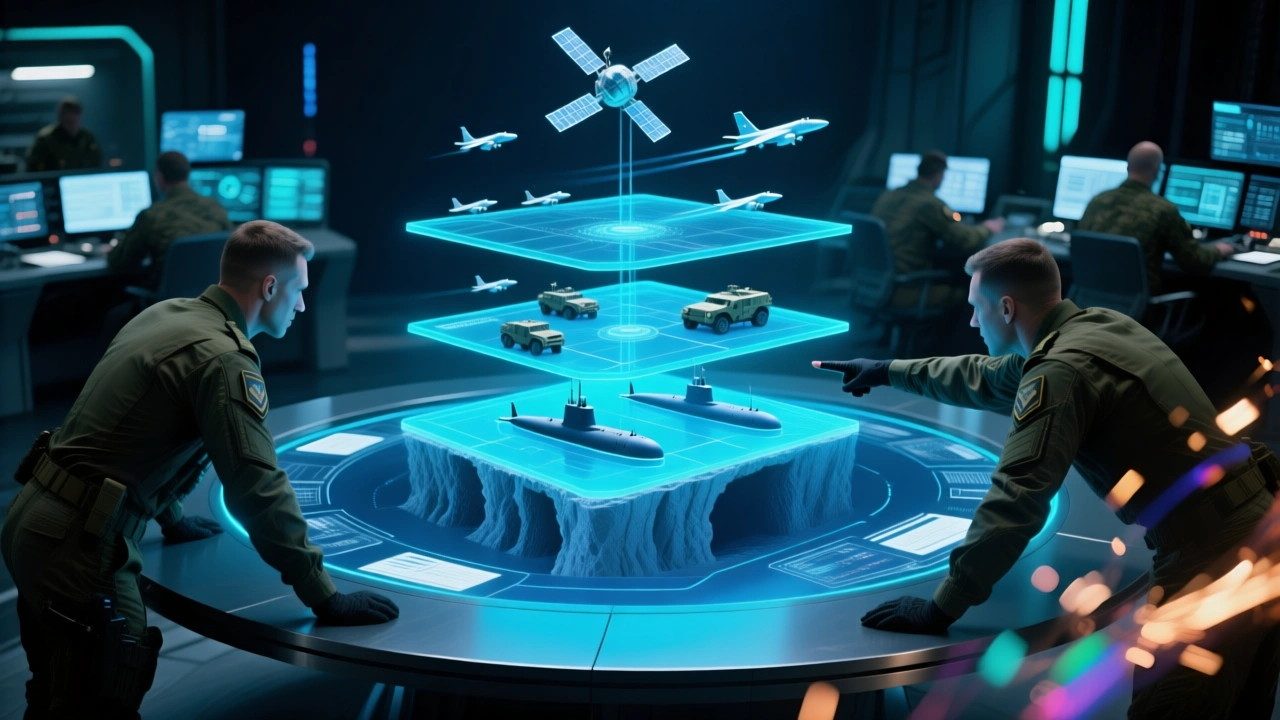
Layers that have no units in a battle simply aren't shown. Most battles use one or two; the stacked view shows how the active ones line up, tile above tile, so you can see which submarine sits under which destroyer.

Concept art: two officers in olive uniforms lean over a round holographic table where a battle hangs in stacked transparent layers, a satellite at the top, aircraft, then armored vehicles, then submarines on a seabed at the bottom.
"Satellites, jets, tanks and submarines share one battle, each on its own layer of the map."

Game layers

  1. 01 · Moment-to-moment

    A turn on the grid

    Deploy, move, attack, capture, build: the Advance Wars rhythm. Terrain decides how far a unit moves, how far it sees and how well it holds, and every unit is good on some ground and bad on other.

    On top of that, the layers: a bomber over the forest is on a different layer from the tank in it, so neither blocks the other, and the fighter above both can see what's coming from orbit.

  2. 02 · Low metagame

    A mission

    From the overworld map you choose among a few generated missions: take a region, hold one you took before, rescue someone, escort a convoy, clean out a nest of hostile robots, or a peaceful job with no fighting at all.

    A mission is one battle of twenty to fifty minutes, with its own map, conditions and goal. Some arrive with a twist: a timer, reinforcements on the way, a base about to be destroyed.

  3. 03 · High metagame

    A universe that keeps going

    The universe runs a passive simulation, and the mission generator reads from it, so no mission is prewritten and none is random either. Win a region and its neighbors react; lose one and you may be called back to it later. Old places come back as new situations.

    You never manage the empire, only watch it, through an overview that's feedback on what your battles changed. The universe has no final mission and no reset: it's an endless adventure with automatic structure, pacing and surprise, there whenever you boot it up.

  4. 04 · Practical game flow

    One battle, or an afternoon in the garage

    Boot the game, look at the map, pick a mission and play one battle of twenty to fifty minutes. The battle is the whole time commitment.

    Between battles, spend as long as you like tuning loadouts and the mothership, or none at all. It's turn-based, so it saves after every turn and you can stop mid-battle without losing a thing.

Game modes

There's one mode: the universe, after the opening campaign on the first planet. Every battle sits somewhere inside it:

The universeA bowl of galaxies and superclusters with wilderness at the edges.
A solar systemStars, planets, moons, belts, gas clouds and stations.
A celestial bodyA planet or moon, split into continents and regions.
A combat areaOne mission's battlefield, on its one to four layers.

It's a singleplayer game at its core, and competitive play against other people is deliberately left out. If more players ever join in, it would be cooperative: players against the universe together, or visiting each other's universes and sending gifts.

Features and mechanics

  1. The heart of it

    Battles in layers

    Advance Wars puts submarines, jets and tanks on one map, so a bomber can't fly past a tile with a parked transport on it. Here the battle map is a vertical slice of the world, split into stacked layers that each have their own terrain, weather and fog of war. Units interact directly with the layers above and below them.

    BattlefieldLayersHow they work
    CelestialOrbit, air, surface, underground or underwaterPlanets, moons, gas giants, stars and big megastructures. Most units live on one or two layers and can't go where their machine can't
    SpaceLocal space and the outskirtsBelts, gas clouds, debris fields and stations. Any unit can hop between the two, at the cost of a full move
    Deep undergroundOne, running verticallyCrust, mantle, outer and inner core, fought downward

    Usually only one or two layers are in use, so a typical battle keeps the fast pace of a normal Advance Wars match. The layers multiply the possibilities without multiplying the work.

    Concept art: a cutaway of one battle in four stacked bands, fighters and a station trading fire in space, jets over grassland below, tanks, walkers and infantry in a city, and a submarine in a flooded cavern at the bottom.
    "Units above and below each other can strike across layers, and aircraft can land and take off."
  2. Up and down

    Crossing between layers

    Units deploy on the surface and move to the layer they belong on: aircraft climb into the sky, satellites rise into orbit on mass drivers or heavy rockets and can come back down through re-entry. Amphibious units cross between sea and land, diggers tunnel down, submarines dive, and transforming machines hop between air and ground.

    Landing follows the ground underneath. A plane sets down safely on an airfield, takes some damage landing on plains, and is lost if it tries a mountain or a forest. Engineers can lay temporary airfields and ports near the front, so aircraft and ships can repair without a long trip home.

  3. Not a static board

    Maps that change

    Terrain changes during a battle, through weather, events, destruction and construction, which makes the game part Command & Conquer and part Into the Breach. Bridges fall, forests burn, new structures go up, and capturable tech buildings and superweapons sit on some maps.

    The environment acts on weapons too: a huge wave washing over the field can stop beam weapons working for a turn. Hazards like toxic gas can be answered with protective gear, at a cost: gas masks keep a squad going but cut its vision.

  4. Foundations first

    Damage from standards, not a chart

    Advance Wars balances every unit against every other unit with a giant damage table, and every new unit means filling in a new row and column. That makes adding content harder the more of it there is.

    Here weapons, hulls and armor, sizes and advanced technologies are standard types, and each unit works out the damage it takes from those types alone, without knowing who's shooting it. A new unit only has to be built from the standards, and it already fights correctly against everything else in the game, including content that doesn't exist yet. That's what lets the arsenal grow without end.

  5. An all-stars arsenal

    Tiers of technology

    The units come in tiers, and which ones you can field depends on the situation: what you own, what you've captured, what tech is on hand and what the mission's resources allow. It's the circumstances of each battle, not an unlock tree.

    TierWhat it looks like
    StandardThe familiar army of infantry, tanks, artillery, jets, ships and submarines
    ScavengerLow-tech raider gear, improvised and cheap
    High techFuture weapons, drones, satellites, orbital strikes
    Ultra techMechs, combinable and transforming units, carrier megabases bristling with guns
    God techHyperweapons and superweapons, with nukes and the defenses against them

    Weapons can fill several tiles at once (beams, barrages, rings, lingering clouds), mounts can be swapped between units the way Super Robot Wars swaps weapons, and there are mobile cities, aerial fortresses, underwater bases and giant land crawlers.

  6. People on the field

    Admirals, heroes and rivals

    Admirals are the commanding officers. As in Advance Wars: Days of Ruin, an admiral can board a unit to make it a veteran and project a radius of their own bonuses; fighting inside that radius charges their power, which spreads the bonus over the whole map for a turn. Rare artifacts called super cores can rewrite an admiral's stats or powers.

    Officers and heroes fight as units with their own abilities. Admirals and heroes on every side are generated, with faces built from parts and personalities of their own, and they can fall for good. Rival admirals remember you, the way Shadow of Mordor's captains do, and between battles visual-novel scenes build friendships, rivalries, alliances and romances, Fire Emblem-style.

  7. Nothing prewritten

    A generator that reads the universe

    Missions come from a heuristics-driven generator, not a dice roll. It looks at the region's state, who holds it, who's nearby, what happened there last time, what it's made of, and builds a battle that fits: the map's layers and terrain, the opponent, the resources, the goal, any twists.

    Maps are assembled from small pieces of terrain and checked to be playable. Resources follow the mission too: steady income every turn as in Advance Wars, harvesting as in Command & Conquer, or only what you deployed with. So two battles in the same region a hundred missions apart can play nothing alike, and both make sense.

  8. Not every mission is a war

    Civilian, science and rescue units

    The same grid tactics work for jobs with no fighting at all. Civilian, industrial, science and rescue units have their own moves and their own terrain strengths, for peacetime missions that build up your headquarters and the federation's cities, and for missions about people: escorting, rescuing, finding or supporting someone you've met.

    They give the universe room to breathe between wars, and give you a reason to care about what the wars are protecting.

  9. Deep, but never in the way

    The garage and the easy battlefield

    Between battles there's a huge library: units, equipment and items to organize in a browser with categories, search and favorites, loadouts to build for your mothership and mobile headquarters, items to carry like Super Mario Bros. 3's inventory. Spend hours there, Armored Core or BattleTech style, or skip it.

    On the battlefield everything stays small: a cap on units in the field, a limited inventory, one resource, inactive layers hidden, and automation for chores Advance Wars made you do by hand, like keeping long supply lines topped up. Most of the extra features can be ignored and the game still plays as plain, fast Advance Wars.

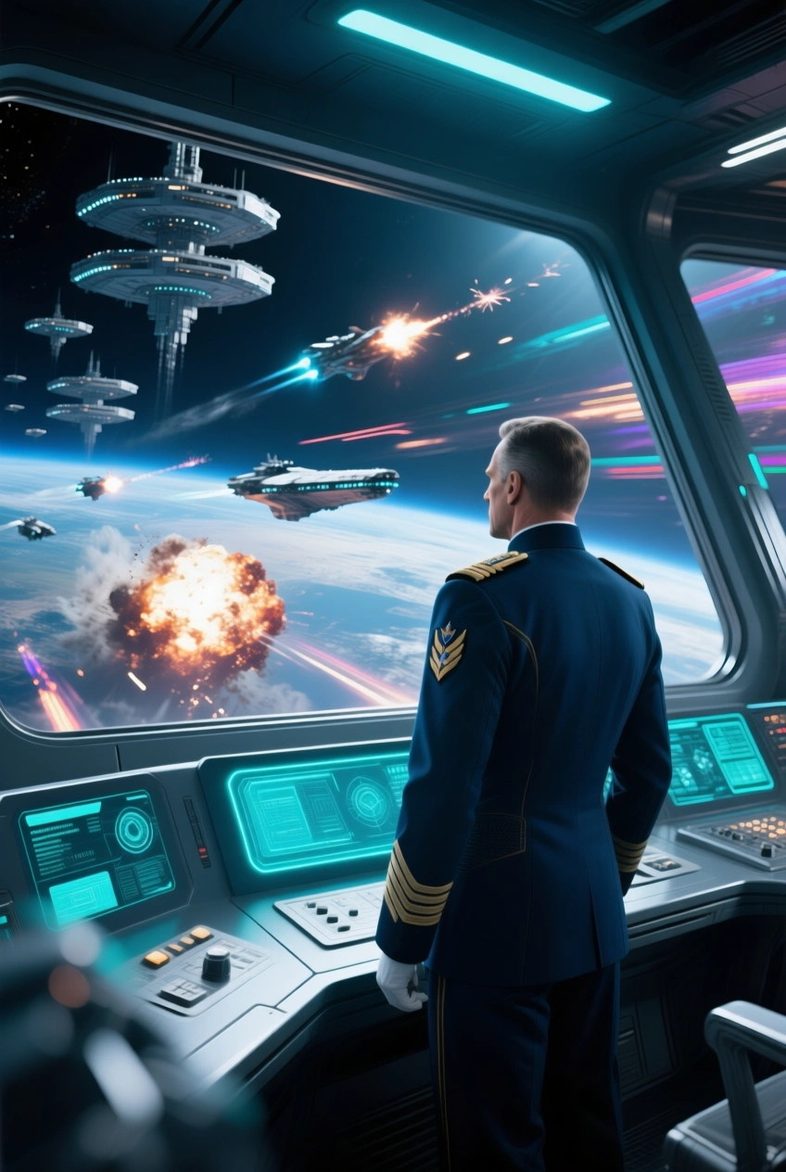
Box art: an admiral in a navy dress uniform with gold braid stands at a starship's console, looking out through a wide window at a space battle above a planet, stations and ships firing and an explosion blooming.

Orders of commission

Admiral Wars Beyond: Four-Layer Grid Tactics

You are hereby given command. Your fleet operates on every layer of every world: in orbit, in the sky, on the ground and beneath it. Your missions will be chosen by you, from the situations the universe presents.

Take your time with every turn. Bring who you trust. Remember who you've lost, and who's waiting for you on the other side.

Report to the bridge, Admiral. The universe is moving.