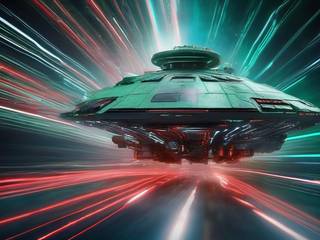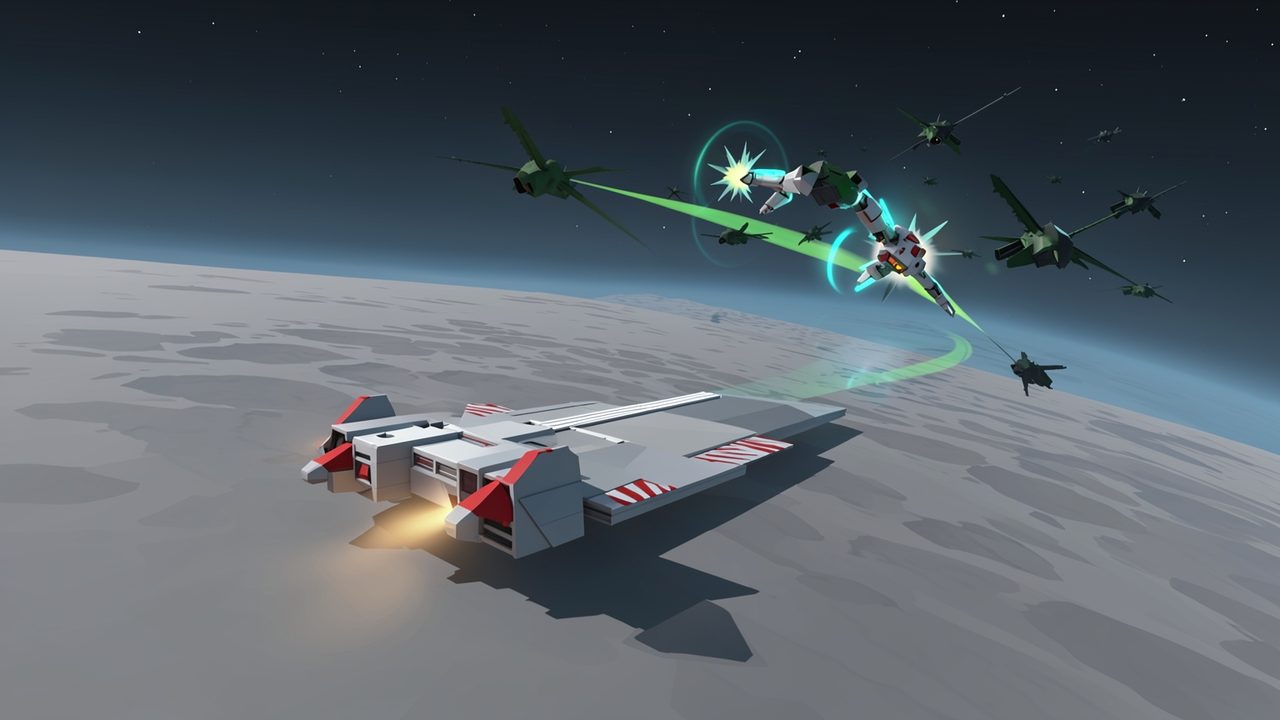
A long grey and white carrier ship with red stripes glides above a grey cratered planet, while far ahead a small white mecha with a cyan-rimmed shield fights among dark green monster ships, a green thruster trail curving behind it.

AAL StandaloneSuper Warrior Mecha

Reactorcore's Personal Game Design Project

Free to forkNo licence and no copyright claim: build this game under your own name, or lift one idea from it. Why?

Game overview

AAL Standalone is a third-person mecha action game about being truly, unapologetically overpowered. You are the AI of a lone superweapon: a transformable mecha that flies, skates and fights at absurd speed, and the armored mothership that carries it, repairs it and builds a new one whenever it's lost.

Each campaign is a generated star system overrun by space monsters. They have their own plans for its planets and you pick your fights, launching off the mothership's catapult into battles on planets and in open space, with momentum physics, infinite flight, beam rifles and guided fusion bombs from the very first minute.

The mecha is yours to throw away. The mothership isn't: it holds the AI, and if it falls, that Standalone unit and its name go onto a permanent memorial and a new unit takes over the fight. It's one of Reactorcore's oldest designs, born from a love of Gundam, Macross, Armored Core, Lost Planet and Knights of Sidonia, and from frustration with mecha games that never let the machine feel like that.

Target audience

Mecha fans who have always wanted to pilot the machine the anime promised: the startup sequence, the catapult launch, the acrobatics, the beam that cuts a fleet in half.

They're tired of western mech games where the giant lumbers, and of Japanese ones where it's fast but weightless. And they like blowing off steam to their own music.

Full 3D flight asks for practice, so the mothership has assisted flight states, the training is in a simulator, and a manual that pauses the game is always one key away.
Game's purpose

Power: abundance, excess and overkill, with nothing held back.

Freedom and excitement: flight that never runs out, momentum you steer with your whole body, and the flow of a long fight played to your own soundtrack.

Meaning: a named unit, a universe that remembers it, and a job worth doing.

It avoids draining rest (nothing kills you without a big mistake) and autonomy (the full arsenal from the start), and it never counts how much of the galaxy you've cleared, so there's no tally to chase.

Core concept

Mecha games usually ration power: fuel limits, speed caps, weak starting weapons, the good stuff earned late.

Here the power is the premise. The danger comes from logistics, numbers and your own recklessness, never from a stat sheet.

Each star system is a finite, generated campaign inside a persistent universe. Losing doesn't reset anything: the next unit inherits the war you left, and the memorial keeps the old one.

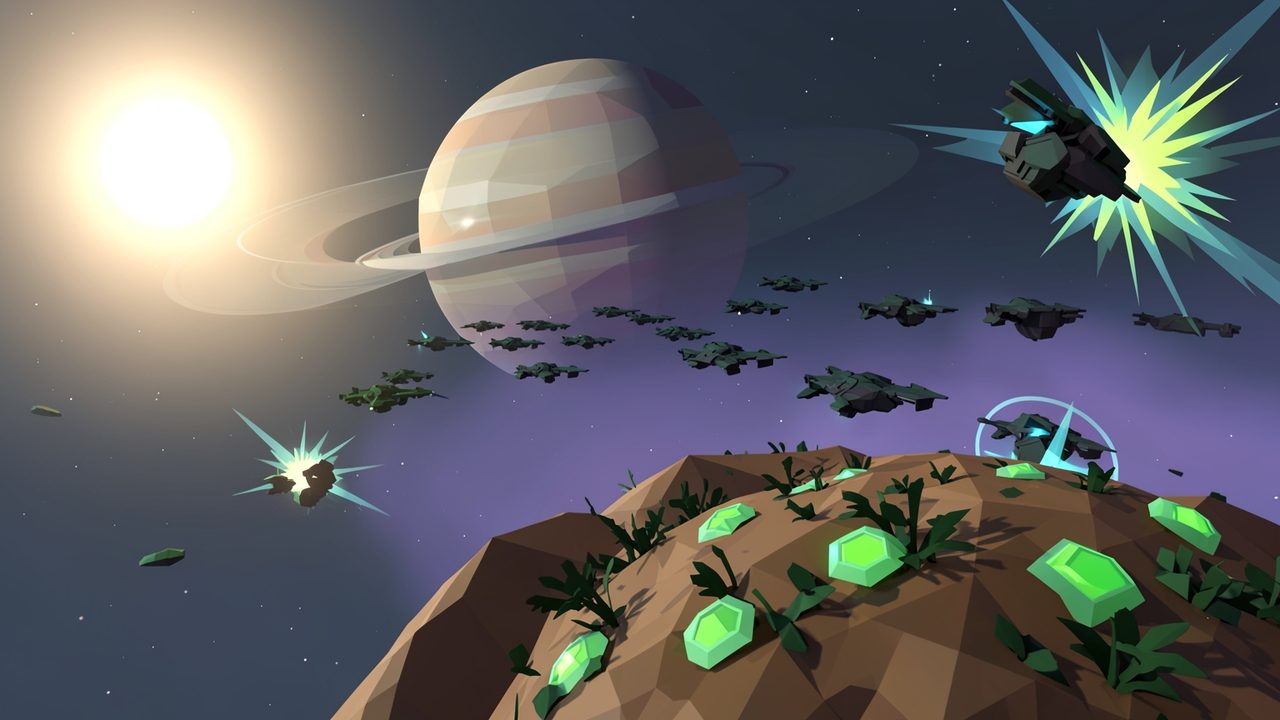
A wide view of a star system: a bright sun, a ringed gas giant and, in front, a rocky brown planet studded with glowing green crystal hives, while a swarm of dark monster ships streams past through a purple nebula.
"The monsters don't want anything from a star system. They just turn it into more of themselves."

Lore and story

The space monsters

The peoples of the Milky Way settled their own galaxy and made peace with every neighbor who could be reasoned with. Then their probes looked outward, and found what lives between the galaxies.

The space monsters aren't an empire or an army. They're many unrelated things with one habit in common: rogue beasts, robots that outlived their masters, self-replicating war fleets, infected zombie armadas, plagues of grey goo. Most are some long-gone civilization's mistake. None of them can be negotiated with, and none of them stop. They land on planets, moons, gas giants, asteroid belts and nebulae, build nests and replicators and factories, strip everything, corrupt what's left, multiply and move on.

The Standalones

The Milky Way's answer is a weapon built to go where no fleet could be sent: a self-sustaining deep-space probe that's also a battleship, carrying a mecha in its bay and an AI in its core. It harvests what it needs, repairs itself and builds what it loses, so it can fight alone, indefinitely, light-years from home. Each unit carries its own ID, like SA-56, and a name.

The first ones had accidents. The later ones were perfected and sent out by the thousand, one star system at a time.

You

You are one of those AIs. You split your attention between the mothership and the mecha, flying one while the other works on its own. There's no mystery to uncover and no plot twist waiting: the game tells you plainly who you are and why you're here, and the rest is the fight.

The job right now

Clear this star system before the monsters ruin it, so people can live there one day and more Standalones can be built from it. Then move on to the next one.

Controls and interface

You fly one machine at a time from a third-person camera that pulls back as you speed up. The other runs itself: the mothership on autopilot following your standing orders, the mecha docked or fighting where you left it. Switch whenever you like.

Mecha: flight

W A S D
Thrust in that direction; momentum carries on until you brake
Space / Ctrl
Thrust up, thrust down
Shift
Boost
X
Brake hard
Tab
Transform between robot and jet

Mecha: weapons

Left click
Fire the rifle in its current mode
Right click
Raise the shield
Wheel
Change the rifle's mode
Hold R
Paint missile locks, release to fire
F
Fusion bomb: tap to throw, hold to guide
B
Buster mode

Mothership

W A S D
Fly, in automatic, assisted or fully manual flight
Left click
Fire the turrets at the pointer
Right click
Charge and fire the main cannon
G
Launch the mecha from the catapult
H
Call the mecha home to dock

Unit

V
Switch between mecha and mothership
M
Tactics screen (the battle keeps running)
F1
Manual and Database (pauses)
Esc
Pause

A rectangular lock-on reticle picks the target nearest its center, and once you open fire the rifle arm leads that target on its own, so you can fly freely while it aims. For a precise shot you drop into first person with a pinpoint crosshair. The interface is styled like a fighter jet's green display, and the game has no music of its own: only weapons, engines and ambience, so you can bring your own.

The same game works as a 3D shooter or as a side-view 2D one. Only the camera changes; the momentum, the arsenal and the campaign stay the same.

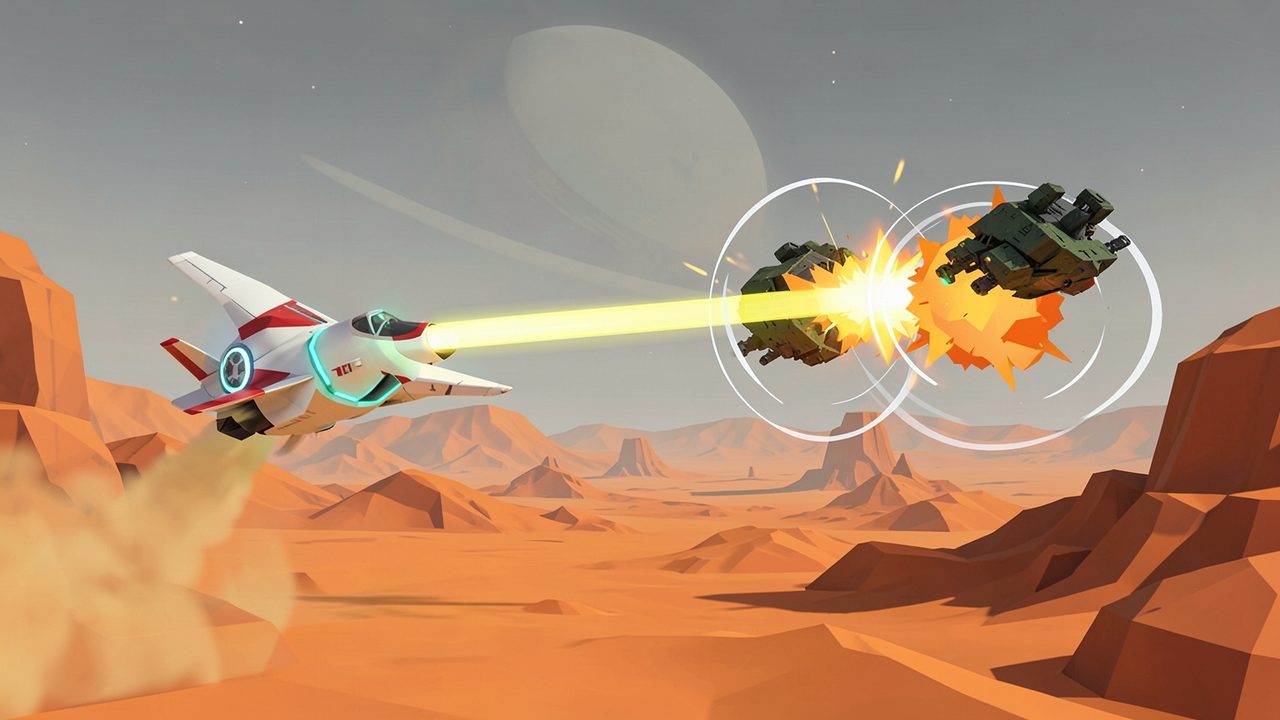
A white and red jet with a cyan-rimmed shield streaks low over an orange desert, kicking up dust, its yellow beam blowing apart dark green monster ships in an explosion ringed by white shockwaves.
"Nothing slows the mecha down but you. Let go of the stick and it keeps going."

Game layers

  1. 01 · Moment-to-moment

    Launch, fight, dock

    You choose where to enter a battle. In space you arrive from the edge, already moving; on a planet you pick a point and an angle and come in through re-entry. The mecha fires off the catapult and the battle is on: skating across a crater floor, flipping to jet form to cross the map in seconds, flipping back to stop on a dime and cut a monster in half.

    Meanwhile the mothership hammers the field with railguns, its drones mine the nearest asteroid, and when the mecha is hurt it docks to repair while the ship covers it. Lose the mecha and the ship prints a new one.

  2. 02 · Low metagame

    One star system

    A campaign is one generated star system on a tile map, like Freelancer's, with zones for its suns, planets, moons, nebulae, debris fields and belts. It may have up to nine suns, or none. The monsters may already have settled in, be in the middle of landing, or not have arrived yet.

    Time on the map runs semi-real-time, as in Star Fox 2: while you travel and fight, the monster groups go about their own plans, spreading toward the next planet and corrupting what they reach. Groups can fight each other too. You decide which threat to intercept first.

    The campaign ends when every threat is gone, and the system is safe. If one place is too far gone to save, the last resort is to detonate its sun.

  3. 03 · High metagame

    The service, and the record of it

    Above the campaign is the work that never runs out: making the universe safe, one star system after another. The universe is persistent and nothing in it is ever reset. The galaxy screen shows the galaxy but not the progress: no map of cleared systems, no running total, nothing to chase except the next system that needs you.

    What the game keeps instead is a log of every unit, every campaign, every system saved or given up, and the memorial of the units that didn't come back. It's a history to read back, not a score.

  4. 04 · Practical game flow

    Put on an album

    Start your music, open the system map, pick a target. A battle runs a few minutes to a quarter of an hour; a star system takes a few evenings.

    The game saves itself constantly, so you can quit at any moment and pick up exactly there. There's no loading an older save to undo a loss, because the universe only moves forward.

Game modes

ModeWhat it's for
CampaignThe real thing: your named unit in the persistent universe, star system after star system. Losing the mothership is permanent.
Quick GameA simulator fight that doesn't count. Generate a random battle or build one, from the world and its weather to the monster groups and your own unit's condition, with any part randomized, locked or hidden for a surprise. No log, no permadeath, retry as often as you like.
TrainingShort simulator lessons in movement, sensors, weapons, systems and tactics, with no danger and no rush. Never forced: you can skip straight to a quick game and figure it out yourself.

Inside the campaign, the structure nests, and you can stop between any of its pieces:

The universePersistent and endless: system after system, unit after unit.
A star systemOne generated campaign: a few evenings.
A battleOne location on the map, from entry to debriefing: minutes.
A sortieThe mecha's launch, fight and return to dock.

Features and mechanics

  1. The heart of it

    One AI, two machines

    You aren't a pilot. You're the AI, and the AI lives in the mothership's core. The mecha, the ReWaR (Remote Warrior Robot), is a proxy body it flies by remote. That one fact sets the game's whole attitude to risk.

    The mecha is expendable. If it's destroyed, the mothership's fabricator prints a new one from harvested resources and catapults it straight back into the fight. So you can be reckless with it, dive into a swarm and see what happens. The mothership is not. It's slower, tougher and carries bigger guns, and if it falls, the AI falls with it.

    The two cover each other. The ship fires support, repairs and rearms the mecha, and recovers it through its docking bay; the mecha keeps the swarm off the ship. You can even leave the mothership out of a battle entirely, at the cost of every repair, rebuild and support shot it would have given you.

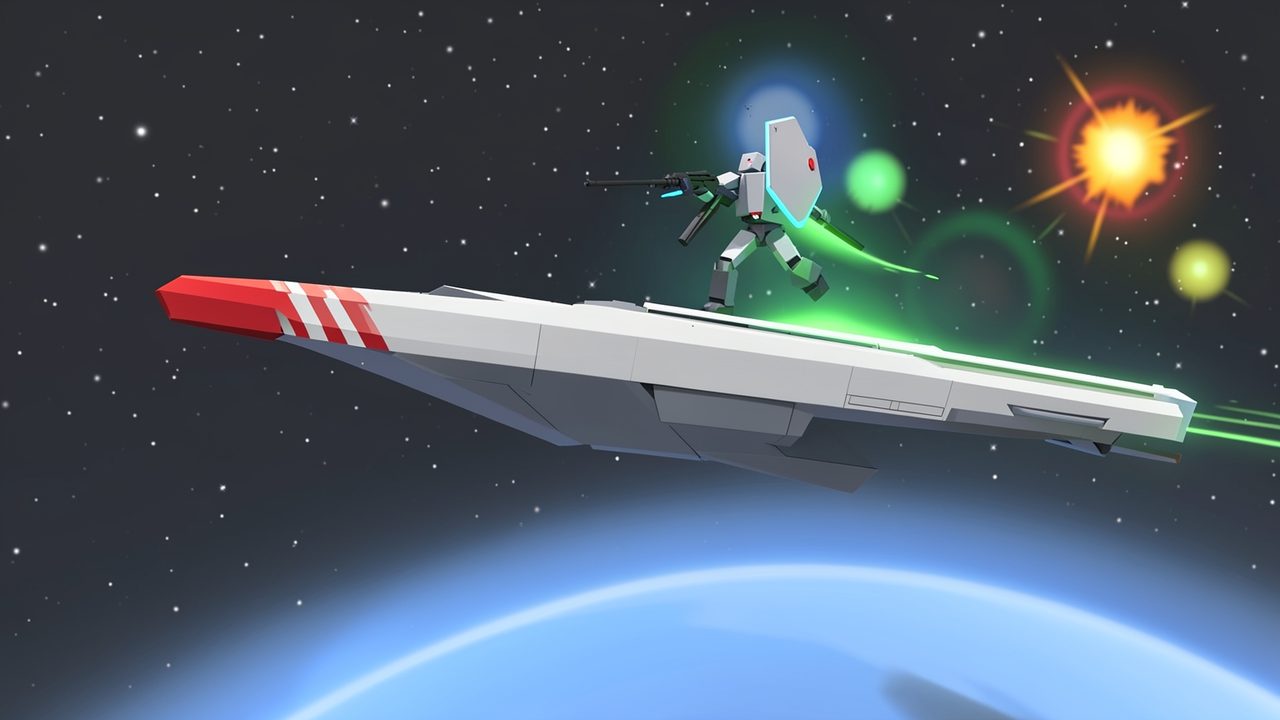
    A blocky white mecha with a long rifle and a hexagonal cyan-rimmed shield leaps off the green-lit launch rail along the top of a grey and white carrier with a red-striped bow, a blue planet below and explosions in the distance.
    "Lose the mecha and the mothership prints another. Lose the mothership and that unit is gone for good."
  2. The way it moves

    Momentum, not friction

    Most mecha games stop you the instant you let go of a key. Here momentum is conserved: no air friction, no speed cap, and you brake on purpose. You move by adding force in the direction you want, so you skate and glide across surfaces and throw yourself around in the air, then turn on a dime, which no plane can do.

    Thrusters cover the whole body: shoulders for turning, waist for strafing and dodging, a back unit for balance and forward thrust, breast and knees for hovering. Flight is unlimited, with no fuel and no overheating, and the mecha can cross a whole battlefield in seconds.

    One key transforms it into a jet that flies behind its shield, rifle mounted down the middle, for extreme straight-line speed and re-entry. The mothership flies too, with three control states: automatic, which keeps it level and makes docking easy; assisted, which keeps it stable while you steer and aim; and fully manual, with roll, pitch and no limits.

  3. Overkill from the first launch

    The arsenal

    Nukes and beam cannons are usually a game's last reward. Here they're standard equipment from the first minute, usable as often as you like. The balance comes from the situation, one unit against whole swarms, not from rationing.

    WeaponWhat it does
    Variable rifleA particle gun fed by the reactor, so it never runs out, only needs a moment to recharge. Modes for every job: heavy machine gun, charge cannon that pierces barriers, spread, flamer, shield, a curved energy slash and a blowtorch blade
    Buster modeThe rifle mounts on the back reactor and opens up: a wide raw beam that vaporizes a whole group, a concentrated cutting beam (a massive laser sword), or the buster bolt, a nuke-grade shot that leaves a crackling trail
    Super shieldCovers the whole body and survives a direct nuclear blast or a death ray. Doubles as the heat shield for re-entry
    Fusion bombsCompact guided bombs from the shield: thrown, dropped, stuck on by magnet, claw or adhesive foam, or flown to the target like a missile, and set off by remote, timer or impact
    MissilesHoming cryo missiles, fired in a swarm at every target you've painted at once, Freedom Gundam style
    BombletsTiny incendiary flares from the legs: they break lock-ons, rain on the ground from altitude, fire backwards like a shotgun, and hang in space as a cloud of mines
    Automatic gunsTwo head lasers and a back railgun turret that fire on their own
    The body itselfKicks, stomps and punches from a hardened frame, after-images from the heat vents, a chaff cloud, a speed lance to plough straight through, and a self-destruct for when it's all over anyway

    Almost everything has modes: detonation by timer, remote, proximity or impact; payloads switched between incendiary, frag, cryo and shockwave; lasers that pulse, charge or stream. Loadouts are set at the mothership or in the field, and the mecha's frame is modular enough to move weapons between slots or swap the standard parts for oversized and undersized guns, each with its trade-off.

  4. Carrier, factory, battleship

    The mothership

    The mothership is a self-sufficient war factory. Its drones fly out to mine rocks, crystals, asteroids and gas; its fabricator turns what they bring back into ammunition, repairs, more drones and new mechas. Everything costs resources, which is where the real tension lives: a ship far from anything worth mining has to think about what it spends.

    It fights, too. Railgun turrets cover every angle, point-defence lasers swat missiles, a missile array and bomb, torpedo and mine bays support the mecha, and a main cannon along its spine can erase a fleet in one shot. It travels faster than light, and a frontal energy field shields it on re-entry.

    From the tactics screen, a map of the battle that never pauses it, you hand out orders while you fly the mecha: move here, fire that at this, harvest there, be aggressive or defensive, dock the mecha, retreat.

  5. No reason, no surrender

    The space monsters

    The enemy is numerous and individually weak. One monster is no match for a Standalone; a system full of them, spreading while you're busy elsewhere, is. Each campaign rolls one or more groups, and each group pursues its own goals on the map: gatherers that strip resources and only fight when attacked, defenders that guard them, nests that grow into factories.

    Every monster is built from a chassis, which gives it a size, a behavior and a trick (a cloak, a shield, an overcharge), and hardpoints that take any weapon or tool. Chassis scale from half size to three times, guns and all, so one design becomes a whole family, and every new part works on every chassis. The first group designed this way is the Robot Starships, self-replicating harvesters gone rogue that remember whoever attacked them and spread that grudge to every ship in the system.

    Some groups also carry supercores, power objects that strengthen them or their whole force. Destroy one, or steal it and use its power yourself, then send it home for study or burn it on one overpowered attack.

  6. Every kill looks different

    Overkill destruction

    Everything in the game, the player, the monsters and the scenery, obeys one universal standard: mass, materials, a hidden health value, and thresholds for EMP, armor, heat, radiation, cryo and knockback. Nothing gets special rules, so whatever works on one thing works the same on everything.

    How a target dies depends on what killed it. A normal kill leaves a burning wreck. Overkill destroys it according to the damage type: steady small damage breaks it into exploding debris and smoke, a big kinetic hit blows it into shreds, heat melts it to nothing, a radiation burst makes it glow and dissolve. EMP crawls across a surface in blue arcs; cryo slows a target, makes it brittle and freezes it solid, until heat thaws it out.

    The look is deliberately simple, low-poly models with flat colors and small pixel textures, so the effects can be big, stylized anime explosions with shockwave rings, the way Star Fox 64 did them.

  7. Two kinds of battlefield

    Planets and open space

    A planet is a huge surface that wraps around at its edges, so there are no walls. You come in from above and leave the same way, back to space. Seas, lava and acid have depths that grow lethal gradually, with warnings, and a gas giant with no ground at all has a crushing depth instead. Space has borders you can exit through anywhere, and some directions grow deadly as you near them: a sun, an anomaly, a black hole.

    Both are built from the same pieces, which the generator combines: solid scenery, liquids, weather bands, and Freelancer-style effect areas (gas clouds, radiation and magnetic fields, nebula fog) that can nest inside each other. Planets range from crater deserts, coal mountains and ice fields to crystal valleys, flying islands and cloud worlds; space from asteroid and ice fields to planetary rings and a sun's corona. Meteor storms and enemy reinforcements arrive with a warning and a countdown.

  8. Nothing un-happens

    The memorial

    Before your first launch you name your unit and choose its colors. That name stays with it. If the mothership is destroyed, the unit goes onto a permanent list of the fallen, with its name, its colors and the record of what it did, and that name can never be used again, much like XCOM's memorial wall.

    The war doesn't reset. A new Standalone arrives in the same system to finish the job, usually to find the monsters have gained ground while it was on its way. Your knowledge carries over; the old unit doesn't.

    If a star system is lost beyond saving, the last resort is to detonate its sun. That stays in the log too, as a loss mourned rather than a score lost. Every save is automatic, with emergency backups kept only for a crashed computer, so the only way through a mistake is forward.

  9. Know your enemy

    The Database and scanning

    The game's encyclopedia lives inside it, part of the manual, and opening it pauses everything. Your own unit is fully documented from the start. The monsters and the worlds start blank.

    To fill them in, hold a target in the missile reticle and scan it. Bigger, tougher things take longer, scans add up across short bursts, and the data is lost if the target dies first. A finished scan adds the monster and each of its parts; enough scans of one group reveal what the group is and where it came from.

    Unknown monsters get a designation like RS-5, the group's code and the order you met them, and you can give each one a nickname of your own, like "Bogey", which the game uses from then on. It's optional depth: useful information for the curious, never a checklist.

Trivia

Standalone is one of Reactorcore's oldest designs. Its working title was Adventures of You, because the AI you played was simply called "You". An even earlier version had a human pilot in a single machine with a supply dropship; the AI and the mothership came later.

Several later designs are set in the peace the Standalones leave behind: AAL Collector, AAL Exterminator and AAL Voyager take place among the outposts and worker bots they built, and AAL Exterminator's smart bomb is modeled on the Standalone's fusion bomb.

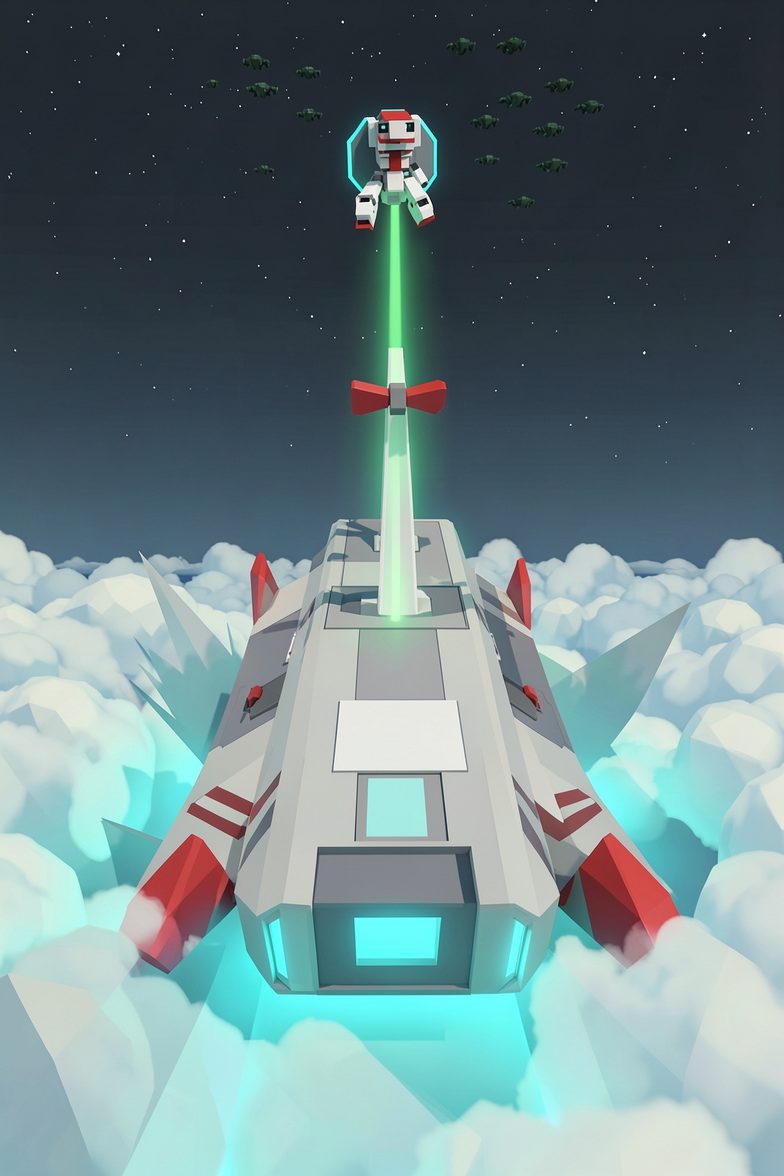
Box art: a long grey and white carrier with red fins rises out of a sea of clouds, engines glowing cyan, as a small white and red mecha shoots up from its deck on a green beam toward a swarm of tiny ships.

Activation order · Standalone unit

AAL Standalone: Super Warrior Mecha

Core online. Reactor stable. Mecha in the bay, catapult charged. Your destination is a star system nobody has heard from in years, and everything in it that isn't you wants to eat it.

You have no fleet and you need none. You have infinite flight, a rifle that never runs dry, bombs that would end a city and a shield that shrugs them off. Lose your mecha and build another. Keep your ship, and keep your name.

Choose your name carefully. It's the one they'll remember.